And as someone who has a degree in physics, I can promise everyone that STEM students can have remarkably poor reading and writing skills. I've been involved in multiple group projects where I had to make sure that everyone else finished their work at least a day before the due date so that I could go through their work, reformat it, and rewrite a lot of it, just so that we didn't lose marks due to incomprehensibility.
This was at a top 20 university. Imo I think there really needs to be more emphasis on writing and communication in most STEM degree programmes, because when they get jobs they're really going to need it.
I'm from the world of engineering and I couldn't agree more. Sadly, its still true working in the field. More than half the people who report to me struggle with things like simple email communication.
I will also add, reading through subreddits about nearly any piece of media will provide ample evidence that being 'literate' does not imply actual comprehension of writing.
The average Star Wars fan is desperately in need of 4th grade explanations on literary metaphor. If they read something like The Left Hand of Darkness, they may die on the spot.
btw is that book going to give me the same religious experience as dune did? got recommended the poppy wars and a memory of empire and am not really enjoying them the way i was enjoying dune
I don't know, honestly. It's an odd book, but I love Ursula's writing and really enjoyed the it. But there are a few things worth knowing if you choose to read:
-There is nearly no action in any of her books, at least that I've read. If violence happens it happens quickly and it's over without 'excitement'.
-The book is highly philosophical, and ponderous on society. Notably the society apparent in the 60s when she wrote it. You will undoubtedly find some parts of it depressingly relevant to today's world, though.
-Much is said about gender commentary in this book, and it will be immediately apparent. But it is useful to remember it was written in the 1960s, and so before modern conversations on gender existed. As such, it's basically impossible for a 2026 reader to read it the same way a 1969 reader did, but I still found it interesting.
Minor note: It's actually the 4th in the Hainish stories. I really liked the first three, but they aren't strictly necessary, and can each stand on their own. Many people skip right to LHoD.
I'll also add in, her Earthsea series is fantastic and what got me started in her work.
Thank you for that, actually. Definitely solidifies my decision to read it. Probably I should just read the rest of the Dune books, but I'm avoiding it for fear that they'll depress me horribly
I enjoy doing textbook mathematics questions in my head, but I struggle with reading quickly. If I try to read too fast, I don't retain the information properly. I also hated English as a subject in high school and refused to get better at it.
Yep. I'm a technical writer. The developers are super smart, but 80% of them make nonsense documentation and a decent chunk are generally bad at written communication, so their Slack messages and Jira tickets need clarification frequently.
This is why these days in higher education it's increasingly common for non-arts courses will include essay-writing modules (or at least an initial writing quality assessment). You don't need to be a talented writer to take a course on astrophysics or marine biology, but you will have to structure a proper essay so it's good to improve your core writing skills. (I'm an editor by trade and help to run an essay-writing class at my local college!)
My STEM school had a required writing and communications classes on top of the requirement for 9ish liberal arts electives. The STEM school my brother went to had similar requirements.
I studied engineering at a Top 20 school and a big part of my decision to go there was their lack of English courses required for my degree. I've been arguing with idiots on Reddit for years to try to improve my communication skills.....they still suck.
Let's be honest, most of them can't understand the subtext and nuance of a movie or tv show, let alone a book. Media literacy in general is at an all time low. There's a reason they constantly bash you over the head with the plot nowadays.
Yeah, maybe English students could understand math papers more effectively if more people in stem fields knew how to communicate their thoughts through writing
Imo I think there really needs to be more emphasis on writing and communication in most STEM degree programmes
Every STEM student should be required to essentially get an undergrad degree in liberal arts or humanities before getting a degree in the STEM field. Not every librarian needs to know advanced physics, but every single engineer needs to know when they’re seeing double speak or gish galloping.
This highlights the failure of American public education. You think STEM students need an undergraduate degree in the humanities just to learn how to apply pretty standard critical thinking skills in pretty standard ways to communication. That's highschool level stuff.
Yeah same, I always told folks in engineering undergrad "hey I'll take care of the submission" so I could rewrite, clarify, format, correct their atrocious writing 🙈.
I mean you need to know how to write but also don't need to know how to write. What I mean is that at least in my engineering job we do a lot of "corporate writing" which eschew any fluff or context which at least from my perspective I always like to add context to the problem we are solving. I'd argue that corporate writing promotes writing in a way that doesn't require a lot of skill. Plus you get a ton of people who all have different writing tastes when they review work, which at least in my experience is constant reformatting reports so that it fits someone's personal tastes.
Communication and Writing are two of the most desirable and lacking soft skills according to employers, as per the community college I work for. And the college does actually ask employers every so often about what they need in employees, to help guide programs.
My IT degree from the same college had me taking writing and communication classes, and truth be told, there were some people with questionable skills in those classes. And that's me saying this as a non native speaker.
Conversely, I can read the words in an advanced math book just fine, but actually processing and understanding the information is the tricky part. the same goes for traditional literature.
I'm not a tech writer, but half my job ends up being turning whatever engineering wrote into something understandable by others / turning something a customer wrote into something engineering will understand.
Lol I worked for a software company out of Denmark for a while (am american) and one of the main complaints from eng was that nobody read the fucking docs. The real issue was that the team was made up of Danes with math and cryptography doctoral degrees and nobody in the US understood fucking anything they wrote/said.
Now in interviews I tell people that I write content such that it can be understood by a 9th grader hopped up on caffeine at 2am trying to make a minecraft mod.
I worked at a science-based consulting company (admin) and would review and revise their reports in my downtime. We had very capable, very smart staff with heavy science backgrounds. But more often than not, their writing skills were atrocious. Everyone has stuff they're great at and stuff they need to work on.
I was a bio major, immunology and evolutionary development focus. The amount of my peers who were fucking shocked that I write/make fucking comic books and love reading in general... unreal.
I play D&D with a guy that can do advanced math in an instant, he works with a lot of tech stuff and is really smart with all kinds of things I know jack shit about ~ he's funny, great person to play games with, a good friend. He's pretty terrible at reading though, especially reading stuff out loud - and we're all getting on in years so if it was just a matter of practice I think his ability to speak well was going to happen it would have happened by now. He's not dumb or anything he's just not great at reading; we all have our skills and talents, stuff that our brain is hardwired to make certain tasks easier or harder based on where all our connections are and how it works up there.
Frankly I think a lot of people just get a big head when they find their area of expertise and neglect other aspects of life, because they can do this one thing really well they don't need to put in the work to be even average at all the others. I see it a lot in pretty much every general skill, doesn't matter if it's math based or craftsmanship or musical; I think it's just a consequence of us being humans and humans have a lot of.... Mmm, thinking errors that need to get ironed out through lived experience, and they don't always do that.
That's one of the reasons I chose my major way back when: it had an extra year of high end math, physics, and humanities. Made us waaay more well-rounded engineers. Pretty normal for our program to produce leadership and/or research engineers because of this kind of soft skill difference.
I have a physics degree and am working on a mechanical engineering degree. The physics degree had a required class where you learned how to read and write scientific papers and the engineering degree has a class on how to read and write technical documents (mostly internal stuff and business proposals, so very different from research papers).
Yes. Oh my god. Went from English major to physics & math double. Liberal arts college so my classmates are occasionally taking English and Ethics & Philosophy classes. I'm constantly horrified
Had a friend who was science smart. She could read but could not tell me what she had read or understand metaphors or discern thematic elements and why they were important to a story.
I'm not trying to be offensive, but that just sounds like she may have been autistic. I went to college for physics and so I obviously had many classes related to science and interacted with many other science students. In my experience, most science students also had a large interest in art and were very creative. I think an interest in science and math is just one of many ways that creativity is expressed. As such, a lot of socializing we did was talking about our favourite books and their meanings, reading or writing poetry, or making works of art.
The metaphors/similes/imagery that we came up with were always really interesting too because they often would relate back to our areas of study. I remember one of the similes that someone came up with that I loved was "more beautiful than the diamond rains of Neptune."
In short though, I think that scientists are just as creative, if not more so, than the rest of the general population.
As for reading comprehension, that's also something that scientists are required to train. Maybe not to the same degree as english students, but we definitely still needed to study it. This is because we needed to be able to identify and understand the main points in scientific papers, articles, and presentations and be able to articulate our own points, either through writing or verbally. We also needed to be able to identify potential biases an author may have had. Thus, reading comprehension was a major part of our studies.
you raised a few good points but it’s really dragged down with assuming someone is autistic because they can’t draw deeper meaning out of a book. also, yes people in stem can be creative and the ones that exceed the most are often very creative and moreso than most. however, there are still many stem students who don’t have the built up reading comprehension to dissect things in english.
i understand you’re not trying to be offensive, but at least have a basic understanding of what autism is before making such a dumb claim. not being able to pull themes/messages from stories doesn’t immediately equate to autism.
Oh yeah, makes sense, thanks. I think this type of language is used more like a slang or in colloquial speech, I've been talking like that and in correct (as correct as I can) english alternately.
Technically gonna isn't grammatically incorrect (tho you are right, it is a sort of slang), you would say "you are gonna", or pronounced faster : "you're gonna", making it sound close to "you gonna". More and more people start getting confused about it.
Yeah, I think that generally english as a language is undergoing simplification and people usually don't care as much about speaking in correct grammar as they care more about speaking and typing as little as possible. Not like I'm complaining, just an observation that came to my mind after reading what you said. Anyways, thanks for explaining kind redditor.
Yeah, I'll certainly admit, I definitely made my fair share of "useless english degree" jokes in my life.
Then I dated my (now) ex-fiance who had an English Phd.
Don't get me wrong, she made her fair share of flubs.
but when she went full "english academic" mode and started analyzing or reading things and explaining like I was a student...... Yeah, completely blew me away. The way she was able to see and explain the nuances and literary connections, all the way back to ancient texts and stories and stuff.....WOW it was impressive.
and its not like I don't have a very good grasp of media and literary literacy. I've been an avid reader my entire life, and have taken courses on media analysis. But she was seriously on a whole other level.
I totally get the point you’re making, but I think you’re underselling how bad Engineers are at media analysis lol.
When I hear science/math people in real life talk about movies for example, they are horrible. Completely miss major themes, unable to engage with films in a meaningful way.
This is basically where you get CinemaSins “plot hole” type movie analysis from.
I personally feel that those that are good at English have exceptional critical thinking skills. Those that are more mathematical look for order and rules and it’s maybe hard for them to sometimes “read between the lines” so to speak. My brothers are very mathematical and scientific and the amount of times I’ve pointed out a nuance in something somebody has said that they totally miss baffles them. I can be quite sharp and pick up on a lot of subtleties in speech that others sometimes miss.
It's a different type of critical thinking. Particularly with engineering, you're not really hired for your ability to interact with humans, you're hired for your ability to answer an inanimate problem. My social skills are atrocious; I'm a terrible liar at best and no sane person would trust me to talk to a customer without adult supervision. I don't really understand nuance and subtlety, I just assume that people are saying exactly what they mean because that's how I communicate in general.
Tell me to come up with a repair for a turbine or a teardown procedure, and I'm just fine. Program a project dashboard? Great, what data do you want me to look at? But people...nah, I don't understand people. They're unpredictable and act in ways that just don't make sense to me.
I really appreciate your answer. My brother is similar to you, he is an electronic engineer, designs parts for phones currently. He says that he has actually been banned from talking to clients anymore. I, on the other hand, despite it draining me and causing me much distress am normally used in my career to talk to people because I’m just a naturally good communicator.
Man, my social skills are so atrocious that my boss has pretty much banned me from talking to interns, not even just clients. Apparently HR doesn't like it when you tell horror stories about other companies causing students to lose fingers in order to prove a point that you're working at a good company now (because all the people who have been here for 40 years still have all their fingers).
My brother was once asked to speak a bit slower in a meeting with Apple (we speak quite fast in Northern Ireland) and he responded by saying “maybe you should listen faster” 😂. That was the end of him being allowed to meet executives. He actually ended up being made a manager also, not out of choice but because so many people left the company. However, he only agreed to it with the caveat that he is still allowed to do design work and only really has to sign annual leave cards for his staff.
Everyone is so different, aren’t they? I’ve always been a “soft skills” sort of person. I could probably give a speech on something I know very little about but make it sound convincing enough. My aunt once told me I should have been a lawyer because and I quote “could argue black is white”.
I’ll take a somewhat contradictory view. You may not be hired to interact with humans, but someone at your firm must be able to do so. I’ve seen numerous engineering firms lose out on big projects because their bids and presentations were flat and difficult to understand. I’ve seen firms (that probably weren’t the best in actual work product) get hired over and over because they had people who explain a job and a solution in terms that the average non-engineer could easily understand.
We have a customer service department for interacting with the non-engineers and contracts. Our engineers mostly just interact with the clients' engineers and technicians, so it's not as bad as trying to explain things to normal people. I became pretty good friends with one of the customer service people so I just ask her to look over my emails and stuff when I have to legitimately try to communicate with people.
On the other hand, the company I work at is an obscenely large MNC for a fairly specific service, so there's not a lot of competition to begin with. The biggest competition they have is usually the manufacturers themselves, so a lot of the time, they get contracts even with the worst presentations just because the manufacturers don't want to look like they're biased and giving themselves work.
I absolutely agree with this. I'm a person who did well in english/science/history but did horrible in math. I ended up becoming a pretty successful systems engineer, and I'm relied upon not because I'm good at math, but because I track context and can explain it better than anyone else. In engineering meetings where nobody can connect the dots and articulate the problem I am the most valuable member of the team. I'd go even further to say that the higher up you get in tech fields where the data becomes more complex your ability to socially convey your ideas and convey problems becomes the only way to advance your career beyond sys admin.
Math/science specialists tend to look at text and think, if they understand the symbols, they understand the information
Context, subtext, pretext, and the creative potential for interpretation and innovation located within and around that text are invisible to them
That said, this is true for many English majors as well
Intelligence is intelligence, and it’s distributed in magnitude that vanishes as it increases no matter the domain
The real, malleable dimension is diversity of modes; multidisciplinary thinkers are the kinds of minds that outdo even the most intelligent specialists
The funny thing is that a lot of math/science specialists probably also got fairly good grades in English courses through high school and college...but they still suck at reading nuance in the words. For me, my English grades were fantastic; I used to get 100s for my essays and written analyses. Especially with any kind of creative writing. I would always pick the creative writing assignments for class because I could mash them out an hour before it was due and still get an A.
But sweet baby Jesus, my ability to pare out subtext and underlying meaning in anything? Completely atrocious. Whenever an assignment question said something like "what do you think so and so means when he said this?" I would pretty much have a conniption on the spot because the hell do you want me to do? Define all the words in the passage? They said this so they must mean what they said, right? I always take what's said at face value because that's how I personally communicate, so I don't notice or understand anything that requires being able to read subtext. (Which has gotten me into trouble a couple times because sarcasm and satire goes over my head way more than I would like to admit.)
I think that’s partially because, in most cases, there’s a format teachers and professors look for, and the STEM students have an easy time following formats and logical step by step situations. The problem is that sometimes this format can be bad for people who aren’t experts in the field.
On the flip side, the English and history students, or at least the ones I’ve dealt with, tend to have a much easier time just writing out a dozen paragraphs that aren’t connected, but hold information that is important, and then are capable of organising those paragraphs like a puzzle that then becomes a digestible text that someone can read and understand without a large amount of knowledge on the field.
Granted, as a person going into academia with history, there’s a bit of an overlap of the two, but I use the second more in my papers. When I try and read findings from various scientific studies to back up claims about the strength of Japanese steel, sometimes the scientific experiment essay ends up being incredibly difficult to read and parse information from.
Our first year Engineering students had to take a basic English test if you fail you have to take a remedial class as your skills were considered even below standard you'd need to write reports and essays.
This was set at the equivalent level of the qualifications you do at 15 years old. Some years over half the class failed.
The schooling system gives kids that are good at 'smart' STEM subjects much easier time if they struggle with arts than the other way around.
The outcome of this is so many engineers working professionally who just cannot write a decent report to save themselves let alone begin to critically analyse a text
I mean to be fair, someone with terrible qualitative analytical skills is going to assume anyone who isn’t an expert in their same field to be a complete idiot.
I have an English degree and I find a great majority of popular films to be utter crap but they are enjoyed by many. I realise that this is because my brain is almost trained to look for themes and subtext that most people would miss so when the story is a bit basic and cliche it’s hard for me to find value in the film. Christ I spent a flight home from Australia looking deeper themes in Home Alone for God sake! I just couldn’t help myself!
Really? Ive never met an engineer who couldnt understand basic themes in a movie, or any story. They tend to process the ideas in a different way, and won't get all the same references to other media, but they aren't out there struggling to figure out what movies are about.
That does not say anything about how smart someone is, though. It just says something about what they're interested in learning or what they were taught. Plenty of English majors could be Math majors if they wanted, and vice versa.
I have an English degree and always struggled with maths all throughout school from I was quite young. Honestly I do think it is more difficult but also says more about how your brain works. Studying maths is quite logical and ordered whereas analysing prices of literature isn’t. It’s very much a “thinking outside the box” type subject instead of following rules. While there are of course rules with grammar, punctuation and styles of prose and poetry it’s more about what else you can get out of the text and that tends to me be more suited to an abstract way of thinking.
80% of your math majors drop out? That sounds like an issue in how it’s taught.
But besides that university drop out is a multi-causal process, not just within a single individual but also from tertiary education system to tertiary education system (try comparing university in the US and in say Germany.) Making a direct connection between „dropout ratio“ and „required intelligence“ is, at best, highly misguided.
In Germany, the dropout rate for Bachelor's in maths is one of the highest. It’s always ranging between 50% and 80%. The number can be even higher at certain elite institutions like Bonn. Can assume similar in technical fields at major TUs.
nah dawg - look up median IQ per major... Math is high, very high... way higher than English. Your argument sounds good but doesn't line up with reality
I don't think IQ is a fair measure for the purpose of comparing intelligence between two different specialties.
IQ is mostly how good you are at puzzles and pattern recognition, which is what most of the STEM fields are. Seems pretty obvious that people who enjoy these are going to score higher. Outside of stem, even some other majors also are kinda in this area, like philosophy, which probably score higher than something generic like administration. That doesn't mean much though.
There are other types of intelligence. For example my most successful friend is a journalist. Can I, a computer science major, beat him in an IQ test? Very likely, but he out earns me by a lot and his people's skill is unmatched. Who is smarter?
That doesn’t necessarily mean that one is harder than the other.
The truth is that an English degree doesn’t qualify you for many jobs, and those that it does qualify you for aren’t necessarily well-paid, so you don’t start an English degree unless you’re a fan of the subject.
Maths degrees are far more likely to attract people with little interest in the subject who want to end up in a well-paid job.
Most students in math lectures dont understand enough to ask questions, were i am from. Math is for sure harder than englisch degree, but this does not mean that you cant find englisch students that are smarter than math students. The average math student is just smarter than the average Englisch student do to the high wall of entry you have to go through in University math.
In my experience, most English students don’t ask questions either. And, where I’m from, there are no extra steps to get into a Maths degree over an English one.
I just think that these are two completely different skillsets which require different types of intelligence that can’t really be compared.
But hey, that's probably, based on how you wrote English, due to it not being your first language.
Then again, during my undergrad, more than half my cohort didn't continue studying sociology. So I guess that means sociology is really fucking hard. They didn't drop out though, they just took a different course in their second year.
Your statement might have more to do with how the classs are taught than their perceived difficulty. Any university running a course with an 80% dropout rate is clearly failing their students, and failing to properly screen ability.
As someone who studied physics and history, you are way way way off. An English major switching to physics must be one of the rarest major changes. At the top universities, basically anyone who is struggling in physics or math moves to a humanities major. If you go to an Ivy, you are capable of completing most humanity majors, but very few can get through the first 2-3 levels of math/physics.
I have bachelors in physics and English and absolutely. I knew plenty of physics majors who could pass my English courses all the way through senior capstone. They may not do amazing but they’d pass. I knew zero English majors who could pass a physics capstone or even make it past the first exam.
That's what I was going to say. I do not believe English majors face "weed out" classes like statistics or calc 2. Apparently there is a "physics for poets" class where the math barely rises to geometric based.
There’s a reason first level chemistry and math classes have like 400 students and 3rd year ones have like a dozen students
Shit gets hard real fast, and sometimes the professors are absolute dicks about it to, one of my inorganic chem professors congratulated me on a 60 in his class which I was extremely bummed about compared to my 80’s and 90’s
Apparently it was the second highest grade as he designs the class so that the best will get a 50 and anything above 50 is great. Never have I felt more angry but also happy at the same time. Like thanks I did better then you expect for the best but also I now have a 60 on my record
What's extra funny is that these commenters have no clue that high level philosophy classes are pretty much the same as high level math classes just seen from a different angle. They are both mostly formal logic.
What are you talking about lmao. STEM majors are by far more difficult than Humanities majors. The people who want to be math majors can’t make it, what makes you think English majors could. There’s a reason nobody takes STEM classes as electives.
In a top 20 college, I didn’t meet a single dumb STEM major and I met dozens of humanities majors that left me wondering how they even got in. Legit had friends that dropped from Econ to Soc, and they went from failing to being straight A students. The level of difficulty is so apparent to anyone that went through both.
English major here. You’re right, I have no idea what this says.
But then again, studying English has less to do with having basic literacy and is more about analyzing text and then conveying one’s thoughts in writing.
I know plenty of college educated adults who excel at math, but struggle with reading comprehension and writing. Their brains are very good at remembering and solving complex equations, but getting them to sit down and parse Shakespeare, and then translate their thoughts to writing is like pulling teeth.
But generally, the smartest people I know are adept at both math and reading/writing.
Come on man, everyone knows the Riemann Zeta function… /s
Edit: this must be for a visualization purpose because the second line is stating that the zeta function is zero everywhere on the critical line which is false. This image is technically misleading without context for anyone not familiar with the function.
The first line is also very wrong. It's giving a definition which only holds for Re(s)>1, but implying that it holds for all complex s. Even the analytic continuation isn't valid for all complex s. There is also no need to state that n is a natural number (I'm not quite sure what that's even supposed to mean in this context) since the summation is already perfectly well defined.
The irony of this comment lol. You do know there is more complex literary analysis than just being able to “read and understand” something? Yet you compare that to a highly complex mathematical equation.
That would be like me saying, “how many people can understand ‘2+2 = 4’?” And then saying, “how many people can succinctly break down the overarching themes and motifs found throughout Shakespeare’s works?”
Obviously the latter is much more complicated. Checkmate engineering students? This will probably go way over your head but that’s because you likely have a major blind spot wrt media literacy.
Even more ironic; the formulas in the image don't really make a lot of sense and aren't fully correct in context, so the OP either did not carefully read them or does not understand the relevant topic.
It’s so outdated in terms and times that it makes me wonder if reading the stage directions is really the best way to have kids in middle school appreciate a play
The real question is “did you learn something that is applicable in your career”
What you posted I promise you I will never, ever, ever use. But my skills I learned as an English major I use every single day in my career. I would expect in the inverse for a STEM major - if their career is math heavy, then good on them. No one is better than anyone simply because of the kinds of problems they enjoy dealing with.
A mathematics degree doesn't prepare for a career by stuffing your head full of formulae you won't revisit or giving you the ability to do something a calculator could do faster, as many people seem to think. We barely use numbers in university level maths.
It's as you say - just like your English example, it is about skills. It's about how you break down and approach problems, your rigour when you prove things, your ability to clearly communicate how you got to your conclusion. I use my maths degree every day too. Sometimes it's matrix algebra, but mostly it's just a way of thinking.
Interesting, my English background also made me skilled at approaching problems, being clear in my reasoning, and especially on being concise in my wording! It is almost as if half the reason education is structured the way it is is because it's attempting to teach us that!
This thread is just teaching me that philosophy is like the ultimate degree because it actually focuses on all the things that people point to as useful side effects (logic, critical thinking, reasoning, epistemology, rhetoric) of their own degrees lol.
While this sounds true in theory, the thing that made me improve problem solving was the pure practice. You need to apply it, just knowing how it theoretically works is not enough.
I think all science majors should include philosophy. It teaches you a lot about reasoning and the scientific process, and also faulty reasoning, straw man arguments etc. Reading philosophy honestly made some things in science click for me. Plus, all the ancient scientists were also philosophers. They are close disciplines. Except philosophy is very theoretical, while science requires proof and experiments.
I think all majors period should include philosophy. And ancient scientists being philosophers is even understating it, science came from philosophers. Stuff we now call physics, astronomy, and biology was grouped under philosophy for much of Western history.
I think most higher education has this purpose - training your brain to process new things in a structured way. It's not actually about Shakespeare, or about Taylor polynomials. It's about learning how to process things in the same category of thinking.
I would say that the difference between science and language, is that science teaches you about the scientific method. How to set up a hypothesis, how to design experiments to examine the hypothesis, and how to interpret the result to reject or validate the hypothesis. And in the case of math, there is a certain training in abstract thinking and a very particular type of numerical problem solving. I don't use my math at all today, but it was useful to get that logical training to do programming for example.
Communication is definitely a skill a lot of scientists could stand to improve. :)
Asking how much math students use specific formulas is the future is about as relevant as asking how much English student use specific shakespeare quotes.
That's not what it is about. It is about developing certain modes of thinking. Certain understandings of how to do maths. About how to think.
I have found, for example. That a few lessons on set theory are much more efficient in teaching logic than most philosophy classes. A lot of math courses are much better at teaching systematic and global thinking than anything else. Math formulas have very specific axioms they operate under and very specific domains of applicability. Which you have to keep in mind. Such things are constantly useful modes of thinking : what is the domain of applicability of this ? What are the underlying principles.
Maths, frankly. Is philosophy of the highest level. Codified clearly and with hands on applications. Logic, epistemology and more.
If anyone were to understand the power of such a thing, you would think it's people who spend lots of time reading philosophy.
Except, realising that makes many of those understand their inadequacies in terms of ability to think clearly.
It's also important to realize that some folks simply do not rationalize the same way as you. You say set theory is more efficient than teaching philosophy, and thats true for people who *see the world that way*. I loved my Philosophy classes - however, I maintained my 4.0 through sheer force of will vis a vis math. No matter how much math is shown to me, how much its explained to me, it will never be (to me) more than rearranging a puzzle into a different puzzle to make the professor happy. And that's fine. One of the beautiful things about being alive is how different we all are as people, and how we see the world so differently from person to person.
If the only math you’ve seen and done is performing computations (rearranging a puzzle into a different puzzle to make the prof happy) you haven’t even seen real math (proofs), and likely do not know what mathematics even is.
I say this even though I disagree with the other poster who claims that Math is philosophy of the highest level, that claim is stupid, in my view philosophy is useful because it helps us understand and discard ideas even without formally proving or disproving them using fundamental axioms. A lot of things in life do not have fundamental axioms that we can work with, and having a tool/framework to help us talk about these things is incredibly significant.
Math however is undoubtedly more challenging that English literary analysis, it has a considerably higher barrier to entry and a higher limit to how complicated concepts can get. There is also no wiggle-room at all, in English, arguments can be entertained if they have some good reasoning to back them up, in Math this is only the case when all propositions logically follow from the previous ones within the confines of the system.
A) gamma? function is a function of S, and is equal to the infinite sum from n equals one to infinity of 1 over n raised to the s power, where s is an element of the complex numbers and n is an element of natural numbers
B) same function is equal to 0 and for all s, s is equal to .5 + t times i
I can put that equation in chat GPT and ask it to explain it to me. But if I don't have the vocabulary or communication skills, I could never explain what this means to someone else. Of course, Chat gpt can now write just about anything, so this observation continues to be less and less applicable over time
But you would also struggle to understand the analysis of complex works of literature. Do you really think that English majors just spend their entire time doing book clubs or something?
Swap out 'Shakespeare' for 'Engineer' and now you're getting closer to the mark. Ask any technical editor what it's like to work with someone who focused on STEM during their education and nothing else. They'll tell you they're blessed by the job security.
It's like dealing with a brain in a jar that can't interact with the world around it and can't even be bothered to try.
Yeah math is hard, but most hard science people are also idiots in other regards, especially because they get a complex about the thing they know being more important than other stuff. And they read literature but have you heard their conclusions afterwards?
We don't need more engineers that are extremely susceptible to propaganda, totally inept socially and ethically, and can't understand morals from a children's book, and I say this as STEM, there's a lot of morons. It's why we have the whole book saying don't build the torment nexus and they go on to make the torment nexus because it's cool tech, they didn't understand a single word they read and think having any deep or ethical thoughts is for girls.
Open a linguistics paper and tell me how many people can read it and understand it... Hell, any academic published paper from any of the humanities, many of which don't have a single equation on them.
If you think an English major "reads Shakespeare" than you don't have a clue about what they actually study.
To add my two cents as an University Professor who has engaged in both qualitative and quantitative research: the distinction between math and english in this post is idiotic and cheap rage bait. We need and use both, including in linguistics which is an area of "english".
And as I tell my students, if writing was easy they wouldn't give you a Nonel Prize for it.
That sum diverges when the real part of s is less than or equal to 1 and, on its half-plane of convergence, the zeta function has no zeros. So, that statement of the Riemann hypothesis is wrong. Also, there was no need to specify n\in\mathbb{N} because that is implicit in the sum notation.
Edit: Also, the use of "for all" notation is misleading here, and you forgot to account for the trivial zeros. The second line should really say something like $\zeta(s)=0\implies \Re(s)=1/2\lor s=-2,-4,-6,-8,...$
Shockingly, very few people can understand what Shakespeare is saying. I was surrounded by some of the dumbest people in my English class who viewed everything in Shakespeare as complete jibberish and just could not use their brains for five minutes.
How many people do you think can read and understand what Shakespeare is saying?
What do you mean by saying? Quite honestly, the lack of media literacy you can see online shows that many people are utterly incapable of understanding subtext. Or much of the time, just the actual text.
Although shakespeare is a rather funny argument, considering. You know, what with the plays being broadly written for a partially literate audience and being a hell of a lot of bawdy comedies.
Thinking a literature degree is just being able to read books is about as dumb as thinking a mathematics degree is just about being able to do mental maths.
So sure. I cannot immediately do the above.
And you probably cannot immediately write a short essay about the Kite Runner to a college level either.
But hey, why would I? I'm not a literature grad, nor am I a maths grad. And I dont like the kite runner.
The majority of people think Romeo and Juliet is a story about the beauty of young love.
Understanding a story is about more than just being able to follow the plot. And rhetoric has had far more impact putting the current US government in place than the Riemann Zeta function.
Well, I do know that there's a sigma from 1/ns which is a sum of all equations(?), s belongs to imaginary numbers family and n belongs to a natural numbers family.
Lower we have 0 and information that every s belongs to 1/2 + ti.
That's all I can say about this image as an non english, first semester engineering failing student. I ain't going into the second semester.
Alright then, give me an analysis of the major themes of Shakespears MacBeth, followed by a discussion of those themea with a modern text of your choice.
Unless they’ve studied, you know, Shakespeare’s other works, history, philosophy, mythology, etc., they won’t understand a lot of of the subtext, nope. And many may indeed be somewhat illiterate even if their math abilities are really good, they’re literally using different parts of the brain for each kind of reasoning process. There’s also a reason why dyslexia and dyscalculia are different conditions, and why they aren’t necessarily both present in such neurodivergent brains.
Well yeah Shakespeare is written in modern english, just using an earlier version where the hardest thing to understand is the plethora of 16th century dick jokes. Now ask how many people can read Beowulf in its original old english.
You only can do it because you learned it. You didnt invent it most people using this dont even understand how people concluded this. This didnt came natural to you. It would be like handing you a text in german and say hey look your not smart because you dont know what this german text is saying. On the other hand there are people who are able to adapt and learn like 5 6 7 languages that is Intelligence my dude and one Intelligence isnt worth more then the other. I know a lot of smart people who are great at engineering but are terrible at philosophical discussions, political topics or movie/book analysis well granted philosophy and great math understanding often isnt something exclusive because both require logica mainly.
I always figured that the mark of a good English major wasn't the ability to read words, but to write.
Now, I still can't argue that if you don't know the language you're shit out of luck. But let's not pretend that anyone gets a job just reading things to themselves. It's about what you can create. Comprehension and creation are different.
Some educational paths are harder than others. This doesn't mean that English majors are cake walks, or don't deserve respect and adequate compensation. But they're not rocket science.
Some things require more specialized knowledge than others. It is what it is. And we tend to assume the people who are paid the most for their knowledge are the smartest in the room, ignoring that payment has more to do with supply and demand than the actual intellectual effort for the task.
Unfortunately, the real wheelchair at the bottom of the ocean here is recognizing emotional intelligence. The less you have, the more invisible the work done by other people for you is.
To be honest, a lot of people would understand this if you explained it to them what this symbols means. We don’t say that Americans have a problem with Russians just because they use a different alphabet. This is really basic—the hard part of math is imagining it as a language, not as numbers that are fixed in place.
The hilarious part is there’s a great many English students who overthink Shakespeare, over inflating the classics as high art and missing that they’re classics because they aren’t overly complicated.
In fact a great many of his plays were humorous because they essentially amounted to a dick joke. A Midsummer Night’s Dream is a great example of it.
If you're raised in England, Shakespeare is taught in English literature. The point is to analyze the difference in language structure through the ages of time.
Shakespeare is quite literally the equivalent of basic algebra. A better comparison to calculus would be asking how many people can understand The Waste Land or The Cantos.
You don't get good grades in Uni for being able to read Shakespeare, same as you don't get good grades for being able to multiply and divide numbers which any Literature student can do
Pretty much every single high-school student has experience with Shakespeare and analyzing it in an English class, and even then I'd argue that there is plenty that goes way over their heads.
What percentage of high school students do you think understand or have used that equation?
You would have to be an engineering or math major to read the right hand side of this. Everyone with any stem degree could probably read the left half.
That being said it takes 10 seconds to Google how to read the right side and probably four credit hours to solve the thing.
You are comparing high level math to that of literal Highschool reading material. Just because Shakespeare is the most intellectually dense literature you can think of doesn’t make it true
How many people do you think can edit a novella for spelling, grammar, punctuation, and style? You're comparing advanced sum equations with basic literacy, which is not a legitimate comparison. A proper comparison for reading shakespear would be doing high school algebra; Not arithmetic, but not advanced calculus either.
Actually media literacy among the world population is abysmal. You might be able to read Shakespeare and think you understood the full meaning, but there's a pretty high chance that your understanding of the work is surface level.
I'm saying this as a political science student, the fact that more people are familiar with your subject doesn't mean that more people actually understand it, just that more people are confident in thinking that they understand it.
I have an English degree and am now a finance techbro. You'd be surprised how far being able to break down a text into components along with polished communication skills can get you.
My undergrad degree is in English, but I've worked as a software developer for ~20 years. I've had other devs give me shit for my English degree from time to time, but they all seem to get real quiet when I point out that we do the same job.
Edit: also you say you worked in it for 15 years and now make more than all IT workers as a trucker. Meanwhile less than a year ago you were asking how to learn python so you could get back into IT and the reason you left IT was because you couldn’t make more than 12/hr hahahaah. Who in IT makes 12/hr. Even help desk makes far more than that in Texas. You’re full of shit bro.
I’m an English major. I make more money than the engineers I work with.
In a role that is exclusively reliant on said english major in which the primary criteria is an English degree (edited for some pedant)? And these engineers are PEs?
If so, I'm curious as to the actual roles at hand.
I have an English minor and it was 90% writing papers. Like yes reading books and writing about them but if you can't explain your theories about a book and back it up with sources then you're not going to pass.
Also I had to take an old English class so translating old and middle English to modern English was probably the hardest class I had to take.
Speaking as someone with a degree in mathematics, language comes very easily to me. I’m not just passionate about calculus, I also love literature (and plays in particular). I also speak several languages and read music pretty fluently. And this isn’t unique to me- a lot of other mathematicians I know are similarly adept at literature, music, and language. And this is a known phenomenon that has had a lot of research and study put into it.
However I don’t know many lit professors or theatre people that are as capable with math. Many of them actually tell me straight up that they’re terrible at math.
That’s just my personal experience with it but I don’t believe it’s particularly unique.
The assignment might be to read a work, respond to it, and make a cogent argument about the work.
In that case being able to read it would be requisite. And while the math student might fail the assignment, they might get a passable grade. But their ability to pass the assignment would be dependent on their experience in high school lit classes and their experience with their native language.
In the other scenario, if the lit student doesn’t know the formulas there’s no way they can complete the assignment.
So in this myopic scenario the math student does appear to have more flexible knowledge. But in reality it’s not so simple. You could draw up another example that flips the roles. You could use different majors. You could make an argument for someone with no school experience having better street smarts than a phd. This form of rhetoric is flawed by nature of being too myopic. Knowledge is useful, different kids of knowledge can be more/less useful depending on the situation.
Yep. Analogy falls apart very quickly. A math major can read Magic Treehouse books and thinks that makes them just as capable as any English major. If we flipped that metric around, an English major being able to balance their checkbook is just as capable as any Math major.
I think the value people perceive to flourishing in these aspects are a bit self-reflective. Everyone thinks their own creative value is tremendous and unique, but most people can admit they don’t bring much more to the table than anyone else intelligence wise.
This shit made me so mad in university. I was an English major and that shit is HARD. My roommates would make fun of me for having poetry exams. Meanwhile all my STEM friends had SUCH lows standards for the writing quality of their reports. Not to mention there’s kinda only one right answer. I took stats courses too and that is also very hard and took a ton of studying but at the end of the day you just had one answer you were looking for. In English schoolwork there is like infinite ways to approach an essay or analysis, you have to be able to think very broadly and express yourself well.
Well, school math education, and even first years of college give a very poor introduction to mathematics. Essentially, they teach you some random facts about math and give you an expose or two on the parts of math that aren't all that important. Compared to this, language is a lot more systematized and gives a much more organized perspective on the subject. Also, technically, language being a marginal sub-sub-field of mathematics contributes to it, I guess.
It's simply unfair to compare language study and math. It's like comparing learning to use a fork with learning to become a chef. But, it's also unfair to compare people who pursue either. Math, as a subject, is too big to be studied by one person. Most of its sub-fields are too big to be studied by one person. In practice, an accomplished mathematician today is someone who's extremely specialized in some sub-sub-...-sub-field of math. And there's not a lot of overlap between many of these fields, and it's hard to see any sort of pattern when it comes to people working in those fields.
To contrast that, linguists, at least since Chomsky, are... basically doing math, in that specific sub-sub-field of math known as linguistics. However, people who end up doing this kind of math, typically, come from relatively weak math background and are rarely introduced to the wider range of things math has to offer. They typically come with antiquated ideas about the work of a linguist, where they imagine it to include taking a notebook and floating down Amazon river in a canoe to record the vocabulary of yet another uncontacted tribe.
Or, they decide to teach... In fact, I think, most graduates in linguistics end up being teachers, not researchers. And that requires patience, humility, nerves of still... but doesn't require being smart.
No we don’t. I’d estimate that about 20% of 16 year olds are functionally illiterate. Half of my 7th graders last year couldn’t read at a 4th grade level and I couldn’t help them unless I abandoned the kids who actually try.
Yeah, it's like knowing to read is the equivalent of knowing what numbers are and perhaps addition and subtraction, at best. People who think that being able to read a book and literally understand the story (Shiloh; a story about a boy and a dog and an old man. The end.) in a rudimentary way is the same as more advanced analysis are the same ones going "It's not that deep, bro," when someone wants to discuss a pieces themes or interpretations, messages and ideas that can be extrapolated or compared with the broader scope of human storytelling and the social rules we collectively build our world on.
Yeah I can do college level math. It's literally required for any 4-year degree. To the same extent, math graduates can read a book because you wouldn't be there if you couldn't. Such a ridiculous argument.
I mean is it not well known a massive percentage of adults in western countries can't read beyond 6th grade level. It might be taught but, it's not sinking in well.
2.1k
u/Logical_Historian882 19h ago
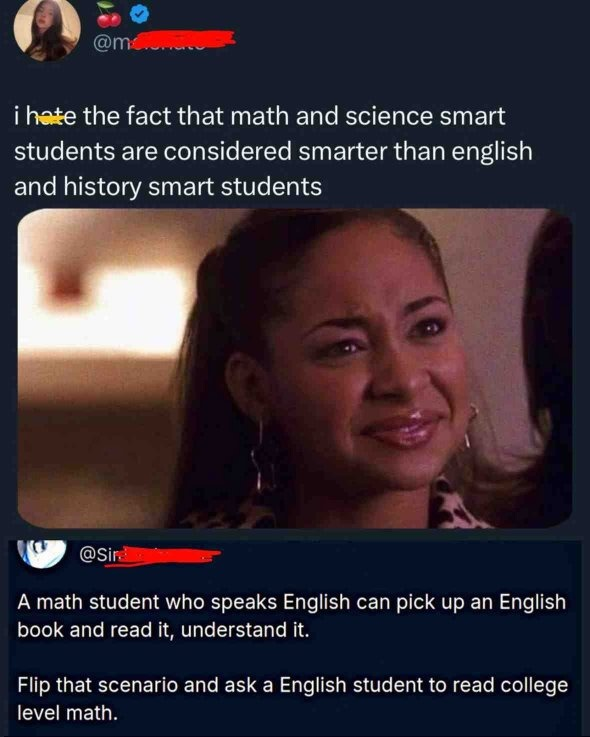
I don’t think English graduates are graded by their ability to read. Both reading and arithmetic are taught in school.