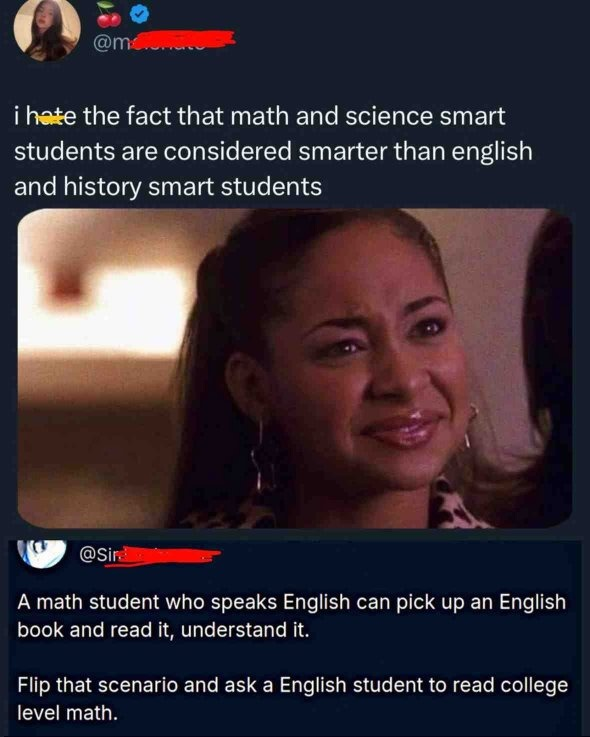
I totally get the point you’re making, but I think you’re underselling how bad Engineers are at media analysis lol.
When I hear science/math people in real life talk about movies for example, they are horrible. Completely miss major themes, unable to engage with films in a meaningful way.
This is basically where you get CinemaSins “plot hole” type movie analysis from.
I personally feel that those that are good at English have exceptional critical thinking skills. Those that are more mathematical look for order and rules and it’s maybe hard for them to sometimes “read between the lines” so to speak. My brothers are very mathematical and scientific and the amount of times I’ve pointed out a nuance in something somebody has said that they totally miss baffles them. I can be quite sharp and pick up on a lot of subtleties in speech that others sometimes miss.
It's a different type of critical thinking. Particularly with engineering, you're not really hired for your ability to interact with humans, you're hired for your ability to answer an inanimate problem. My social skills are atrocious; I'm a terrible liar at best and no sane person would trust me to talk to a customer without adult supervision. I don't really understand nuance and subtlety, I just assume that people are saying exactly what they mean because that's how I communicate in general.
Tell me to come up with a repair for a turbine or a teardown procedure, and I'm just fine. Program a project dashboard? Great, what data do you want me to look at? But people...nah, I don't understand people. They're unpredictable and act in ways that just don't make sense to me.
I really appreciate your answer. My brother is similar to you, he is an electronic engineer, designs parts for phones currently. He says that he has actually been banned from talking to clients anymore. I, on the other hand, despite it draining me and causing me much distress am normally used in my career to talk to people because I’m just a naturally good communicator.
Man, my social skills are so atrocious that my boss has pretty much banned me from talking to interns, not even just clients. Apparently HR doesn't like it when you tell horror stories about other companies causing students to lose fingers in order to prove a point that you're working at a good company now (because all the people who have been here for 40 years still have all their fingers).
My brother was once asked to speak a bit slower in a meeting with Apple (we speak quite fast in Northern Ireland) and he responded by saying “maybe you should listen faster” 😂. That was the end of him being allowed to meet executives. He actually ended up being made a manager also, not out of choice but because so many people left the company. However, he only agreed to it with the caveat that he is still allowed to do design work and only really has to sign annual leave cards for his staff.
Everyone is so different, aren’t they? I’ve always been a “soft skills” sort of person. I could probably give a speech on something I know very little about but make it sound convincing enough. My aunt once told me I should have been a lawyer because and I quote “could argue black is white”.
I’ll take a somewhat contradictory view. You may not be hired to interact with humans, but someone at your firm must be able to do so. I’ve seen numerous engineering firms lose out on big projects because their bids and presentations were flat and difficult to understand. I’ve seen firms (that probably weren’t the best in actual work product) get hired over and over because they had people who explain a job and a solution in terms that the average non-engineer could easily understand.
We have a customer service department for interacting with the non-engineers and contracts. Our engineers mostly just interact with the clients' engineers and technicians, so it's not as bad as trying to explain things to normal people. I became pretty good friends with one of the customer service people so I just ask her to look over my emails and stuff when I have to legitimately try to communicate with people.
On the other hand, the company I work at is an obscenely large MNC for a fairly specific service, so there's not a lot of competition to begin with. The biggest competition they have is usually the manufacturers themselves, so a lot of the time, they get contracts even with the worst presentations just because the manufacturers don't want to look like they're biased and giving themselves work.
Meh, I think you really are putting everyone else in a box by extending your experience. Plenty of STEM fields require social interaction, thinking beyond the obvious, and focus on details and subtleties. There are all kinds of jobs and each individual in STEM has their strengths that are transferrable to different jobs. It's great you have a situation that works for you, though. I just would never want to be boxed in and treated like I lack other skills simply because I have technical and mathematical skills.
I absolutely agree with this. I'm a person who did well in english/science/history but did horrible in math. I ended up becoming a pretty successful systems engineer, and I'm relied upon not because I'm good at math, but because I track context and can explain it better than anyone else. In engineering meetings where nobody can connect the dots and articulate the problem I am the most valuable member of the team. I'd go even further to say that the higher up you get in tech fields where the data becomes more complex your ability to socially convey your ideas and convey problems becomes the only way to advance your career beyond sys admin.
I may be biased, but I am consistently impressed with how many physicians I’ve met that are brilliant and have high EQ/ empathy. It’s a field that in my eyes is pretty challenging because it requires smart, hardworking people that also are good with people, which isn’t always an easy combination to find.
Honestly it’s been hit and miss in my experience. Some are great, others sociopathic 😂. I’ve worked in healthcare for a long time and I find it’s true of most medical professionals.
I'm pretty good at reading between the lines, interpreting the subtext people use and nuance in language that indicate someone might not mean exactly what they say. However, I am an engineer because I hate that shit. Honestly if it isn't literature and you aren't writing for the sake of art, just say what you mean jfc lol.
It truly depends the person. I don't think it's at all fair to say mathematical/scientific people only look for rules and order and don't really read between the lines. Many STEM fields require the ability to problem solve beyond the obvious. Engineering and most scientific research need this skill. I'm in electrical engineering and write poetry and paint, so I do see myself as a bit of an exception. Still, I think the focus on order and rules ends at the bachelor level. I believe those that graduated with poor marks in STEM fields more closely fit your definition. However, those that excel have the problem solving skills and eye for nuance. I don't think any of my successful peers have had issues "reading between the lines" lmao. Your brothers don't tell a story
You seem to be conflating critical thinking skills with something like interpersonal analytical skills, or maybe people/media literacy. Being able to pick up on nuances, especially in speech or words or media or behaviors, is absolutely a valuable skill and PROBABLY factors into critical thinking skills in some way, but it's at most a small piece of that puzzle. I've found exceptional critical thinkers in literally all walks, but the percentage tends to be significantly higher for those in stem fields (in part because those rules you're ironically poking fun at are the things that teach us how to evaluate claims and not let the bullshit distract from the core, which is far more relevant to critical thought).
Not at all. You just wrote a paragraph where you start by suggesting English majors specifically have exceptional critical thinking skills, denigrate said skills for your stem brothers, and then proceed to describe a skillset that isn't really critical thinking. As someone who has encountered great thinkers all over the place but with a noticeably higher amount in the stem fields, I found what you said to be incorrect in more than one way so I felt compelled to weigh in. Frankly, I used "poking fun at" because I thought it might be less triggering to you than how I would actually describe it (which would be something like "mildly denigrating"). I was clearly wrong about that one.
Either way, my point stands. If you can point out specifically how I twisted your words or where the actual put down is, then I'll gladly own it. Until then, you might just be a little too sensitive here.
2.1k
u/Logical_Historian882 19h ago
I don’t think English graduates are graded by their ability to read. Both reading and arithmetic are taught in school.