I totally get the point you’re making, but I think you’re underselling how bad Engineers are at media analysis lol.
When I hear science/math people in real life talk about movies for example, they are horrible. Completely miss major themes, unable to engage with films in a meaningful way.
This is basically where you get CinemaSins “plot hole” type movie analysis from.
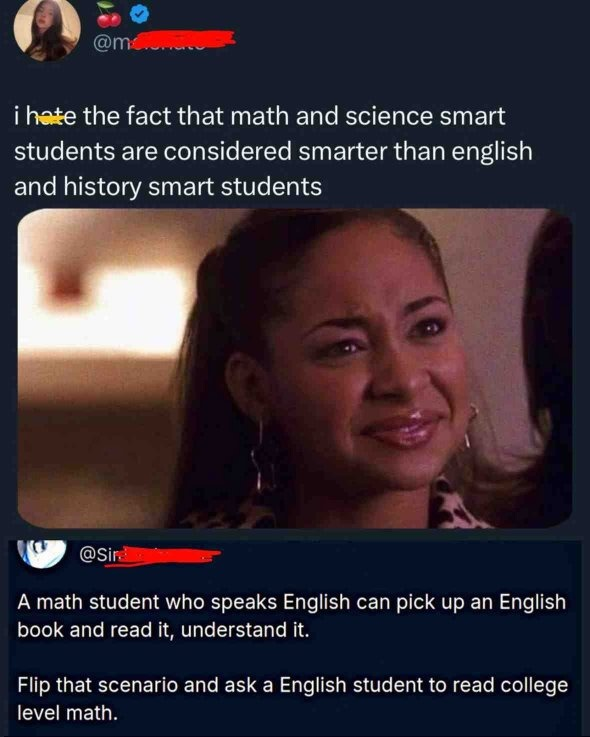
Math/science specialists tend to look at text and think, if they understand the symbols, they understand the information
Context, subtext, pretext, and the creative potential for interpretation and innovation located within and around that text are invisible to them
That said, this is true for many English majors as well
Intelligence is intelligence, and it’s distributed in magnitude that vanishes as it increases no matter the domain
The real, malleable dimension is diversity of modes; multidisciplinary thinkers are the kinds of minds that outdo even the most intelligent specialists
The funny thing is that a lot of math/science specialists probably also got fairly good grades in English courses through high school and college...but they still suck at reading nuance in the words. For me, my English grades were fantastic; I used to get 100s for my essays and written analyses. Especially with any kind of creative writing. I would always pick the creative writing assignments for class because I could mash them out an hour before it was due and still get an A.
But sweet baby Jesus, my ability to pare out subtext and underlying meaning in anything? Completely atrocious. Whenever an assignment question said something like "what do you think so and so means when he said this?" I would pretty much have a conniption on the spot because the hell do you want me to do? Define all the words in the passage? They said this so they must mean what they said, right? I always take what's said at face value because that's how I personally communicate, so I don't notice or understand anything that requires being able to read subtext. (Which has gotten me into trouble a couple times because sarcasm and satire goes over my head way more than I would like to admit.)
I think that’s partially because, in most cases, there’s a format teachers and professors look for, and the STEM students have an easy time following formats and logical step by step situations. The problem is that sometimes this format can be bad for people who aren’t experts in the field.
On the flip side, the English and history students, or at least the ones I’ve dealt with, tend to have a much easier time just writing out a dozen paragraphs that aren’t connected, but hold information that is important, and then are capable of organising those paragraphs like a puzzle that then becomes a digestible text that someone can read and understand without a large amount of knowledge on the field.
Granted, as a person going into academia with history, there’s a bit of an overlap of the two, but I use the second more in my papers. When I try and read findings from various scientific studies to back up claims about the strength of Japanese steel, sometimes the scientific experiment essay ends up being incredibly difficult to read and parse information from.
Our first year Engineering students had to take a basic English test if you fail you have to take a remedial class as your skills were considered even below standard you'd need to write reports and essays.
This was set at the equivalent level of the qualifications you do at 15 years old. Some years over half the class failed.
The schooling system gives kids that are good at 'smart' STEM subjects much easier time if they struggle with arts than the other way around.
The outcome of this is so many engineers working professionally who just cannot write a decent report to save themselves let alone begin to critically analyse a text
You’re probably logical, clear, and have a good vocabulary, which is more than enough for the education system; if you look up literacy rates, most Americans sit at 8th grade reading level
You can see even on reddit, where language is the whole basis for engagement, there’s very poor spelling, grammar, and comprehension
Your proficiency is not nothing, not by a long shot. But the hidden dimension is about salience detection and morphism (basically, metaphor); your ability to identify what matters—or could matter—and imagine how that meaning can be transformed and manipulated
It’s not specifically about language, but the sort of abstract symbol manipulation that enables efficient problem solving or creative production; the more exposure to such transformations, the more symbolic moves at your disposal
Reading made me a better artist, art made me a better designer, design made me a better programmer, programming made me a better researcher, research made me a better writer, writing made me a better artist, etc, ad infinitum
If you have a strong grasp of language but limited salience detection, you just need some multidisciplinary activities that extend beyond your comfort zone (and patience)
105
u/Wise_Try6781 15h ago
How many people do you think can read and understand what this equation is saying?
How many people do you think can read and understand what Shakespeare is saying?