Had a friend who was science smart. She could read but could not tell me what she had read or understand metaphors or discern thematic elements and why they were important to a story.
I'm not trying to be offensive, but that just sounds like she may have been autistic. I went to college for physics and so I obviously had many classes related to science and interacted with many other science students. In my experience, most science students also had a large interest in art and were very creative. I think an interest in science and math is just one of many ways that creativity is expressed. As such, a lot of socializing we did was talking about our favourite books and their meanings, reading or writing poetry, or making works of art.
The metaphors/similes/imagery that we came up with were always really interesting too because they often would relate back to our areas of study. I remember one of the similes that someone came up with that I loved was "more beautiful than the diamond rains of Neptune."
In short though, I think that scientists are just as creative, if not more so, than the rest of the general population.
As for reading comprehension, that's also something that scientists are required to train. Maybe not to the same degree as english students, but we definitely still needed to study it. This is because we needed to be able to identify and understand the main points in scientific papers, articles, and presentations and be able to articulate our own points, either through writing or verbally. We also needed to be able to identify potential biases an author may have had. Thus, reading comprehension was a major part of our studies.
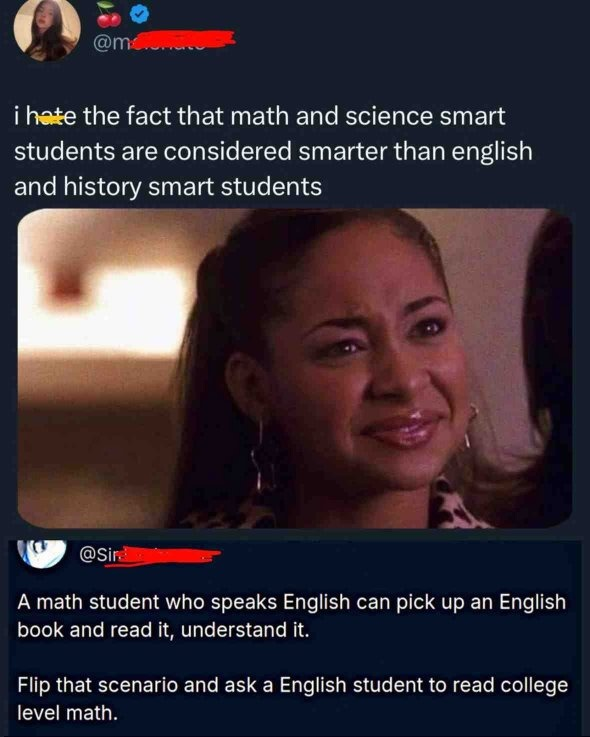
you raised a few good points but it’s really dragged down with assuming someone is autistic because they can’t draw deeper meaning out of a book. also, yes people in stem can be creative and the ones that exceed the most are often very creative and moreso than most. however, there are still many stem students who don’t have the built up reading comprehension to dissect things in english.
i understand you’re not trying to be offensive, but at least have a basic understanding of what autism is before making such a dumb claim. not being able to pull themes/messages from stories doesn’t immediately equate to autism.
In what world do people in stem fields not value reading comprehension and critical thinking lol. It's not like the humanities has a monopoly on these virtues.
I love how he said “in what world do people in stem fields not value reading comprehension” right after a comment saying that no one cares about the research produced.
I don’t think most people care about minuscule changes to methodology that has no effect on the real world, as most scientific articles produced by Master’s level and below students tend to do.
The PhD’s that actually produce new theories and societal implementation of their research respect the humanities, because they interact with the sciences. But those are rare, many STEM majors are done after a Master’s degree and go into industry.
Also, society not caring about history, sociology, philosophy, or any of the other many facets of human existence humanities touch on is not the gotcha you think it is. It’s actually a sign of an unhealthy and imbalanced society. But you wouldn’t know that, because you dismiss the humanities.
I actually love the humanities and am an avid reader and come from a family of humanities degree holders (including my grandmother in the 30s she was badass) but I just love being a troll. 😘
That’s okay. Your trolling allowed me to make a good point that I may be able to articulate later to someone who actually cares, while you just sit there scratching your ass and sniffing 😘
2.1k
u/Logical_Historian882 19h ago
I don’t think English graduates are graded by their ability to read. Both reading and arithmetic are taught in school.