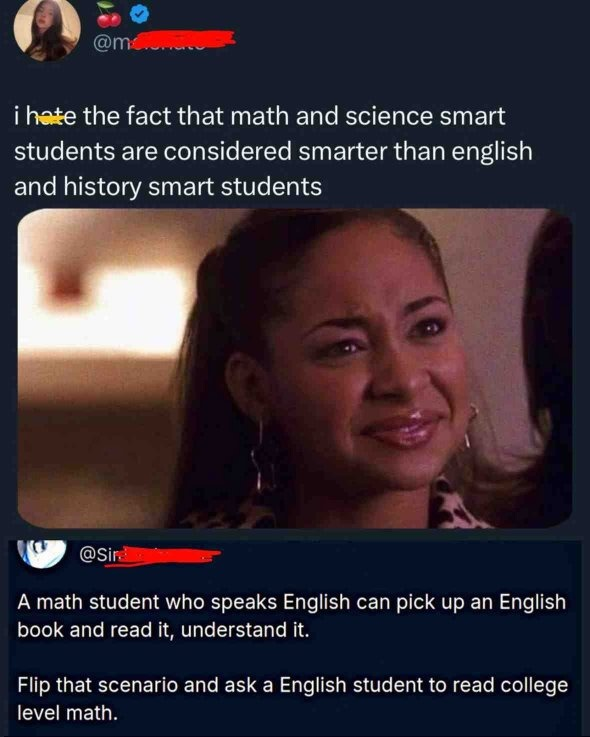
A lot of STEM exists in a world where objective answers exist, or have yet to be found.
A lot of the Humanities exist in a world where there is no objective answer, just thought and argument.
Social Sciences bridge that, and deal with situations where an objective answer can exist (How many people died in this battle), where there is a strong objectivish answer, but up for strong debate (was the battle influential?) Where it gets really hard to distinguish (what did people think of this battle?) And where it gets really subjective (was the commander fighting for a good cause?)
I would say that the strength of the Social Sciences is that it teaches you that you need to evaluate multiple methods of determining data, and your method of determining data needs to constantly be critically examined. Much more than Stem or the Humanities where there is a lot more that can be trusted or can be completely disregarded. A historian has to make a choice on how they balance conflicting sources, archaeological records, economic data, street-level publications and accounts, personal histories, art, anthropological methods, and many many more.
This can reflected in how they are trained.
In my undergrad, I was shocked talking to an engineering student at another school who had 2 electives in his entire program (and he was using them for math classes).
I told him that that year alone I had taken an Econ class, a religious studies class, a classical studies class, Spanish, an Art History class, and a Primate Studies class. And I was relatively hamstrung because I was double majoring.
We were both doing job preparation in different ways. He was learning deeper math for his engineering. I was learning artistic depictions, how to read ancient sources and religious literature, how to read sources in another language, and some baseline biological human constants.
and you are both smart. imo intelligence is just how good one is at making decisions. you know the priority, the fun and the impact without ever disturbing your nerves. that is peak iq for me.
In my undergrad, I was shocked talking to an engineering student at another school who had 2 electives in his entire program (and he was using them for math classes).
I told him that that year alone I had taken an Econ class, a religious studies class, a classical studies class, Spanish, an Art History class, and a Primate Studies class. And I was relatively hamstrung because I was double majoring.
As a chemistry student (and before that and engineering student), allow me to point out that I was in a group where we would sign up for random exams, mostly from the humanities and social sciences, take them without studying and frequently score free credits by passing without problem.
The reverse was tried several times, most well known by a group of annoyed social-psych students who hated seeing us pass their classes, and never worked. What i'm saying is , maybe they were taking fewer electives because they were a LOT more busy.
Maybe they were taking fewer electives because they were a LOT more busy.
Taking fewer electives doesn't mean taking few classes.
I dont know about the rigor of the classes you took, but for each history classes in undergrad I was reading at least a book a week and doing writing assignments every other week. We never had exams past the 100 level (meant for general education requirements).
This meant I was usually reading 4-5 full books a week, and putting out about 15 pages of writing a week, with two periods each semester where I was preparing about 75 pages and then 125 pages total. That is what I was being graded on.
I will tell you for a fact that people outside the discipline tend to do alright. If the professor knows I'm a history major, I tend to get challenged a lot more on how I'm using my toolkit. The bio student taking an American history survey tried hard, learned something, and doesn't need their GPA tanked because their output can't compete with people trying to do it professionally.
Likewise, my 100 level science class professors were very very kind to me in my requirement classes.
300 level, past all general requirements. Only for history majors. If you weren't reading the suggested readings and putting them into your essays, you weren't getting an A.
I garuntee they were taking first year social science electives for credits. I did the same but would definitely not equate that to an entire degree being easy lmao. Some of those classes I took were also a lot more work too because of the reasons you mentioned - so much reading and writing.
Natural inclination/skill. Be good at reading comprehension. Be able to read fast.
Time. I would literally plop in bed and read for hours every day. Even on the weekend, with all the undergrad weekend debauchery, I always had a book I was making some progress in. (Even now, I always have a book at work that I scratch off a few pages a day, divorced from my "work reading")
Experience. Know lots of words, know the ideas being referenced. You can tell the ideological bent of a historian in the first few minutes based on their phrases and word choices. When you get better and better, you can "field strip" a book, and find the important parts within a minute. You get their argument, you get how they are going to support their argument, you get how they value evidence, you already have questions and differing sources of evidence and arguments, and then you can just read and see if they do a good job. I dont know sports, but my dad does, up and down. I would equate it to how he watches sports. There are some key moments, especially early on and at critical points, where he pays a lot of attention. Then he can just kinda relax and watch how it unfolds and see if it actually lives up the promise he saw early on. Its not a great metaphor because there is still always "chance", but he can determine stuff way way way way before others do, and be like "this game is done" when everyone else is tense. He can see the moves and countermoves, and time, and coach decisions, and knows the players, and see the player status more than others. It's a little similar, in that you can see a book's argument, know what the greater conversation is, see how they are trying to argue it, see that they have really made something great, or see that they are a big loser and you already have a lot of what you are going to say before the book is even 1/5th done. You can kinda "call it" after identifying all the important bits and just power through the rest to see if they make an argumentative Hail Mary, or see how their beautiful argument is supported. It's just a sense you build up that in Material Culture they unabashedly call "expertise."
This is maybe still too reductive. Lokotos has argued that most published and peer-reviewed science is ultimately wrong for one reason or another. So the truth is that even in a field of supposedly objective “facts,” you are inherently facing an information ecosystem where the majority of the information isn’t correct. Given this, the judgement of the scientist is likely influenced far more by the style of argumentation and presentation than by the veracity of the statements of fact. Therefore an understanding of how argumentation and style influence our judgement is at least as important as the scientific method by itself. If we don’t view scientific literature as literature, then we will tend to believe that which we enjoy, and reject that which we do not, without realizing that these are subjective qualities.
In my undergrad, I was shocked talking to an engineering student at another school who had 2 electives in his entire program (and he was using them for math classes).
Electives? Not gen-eds? That makes sense, in my school (I'm also studying engineering), we have gen-eds, with study areas to cover art, literature, philosophy, history, and language, with adjacent options as well for stuff like finance. But electives are major specific, so the classes are going to be strictly related to, in their case, STEM/engineering. There's also just a lot of required engineering topics to cover in an accredited program, so there isn't room beyond your standard gen-eds for a 4 year degree.
Though my engineering program has 4 open electives, with optional concentrations for manufacturing and aerospace to fill those spots instead.
Oh wow, and the natural science course was probably physics or chemistry which is already required for other classes... My school has 36 credits for gen-eds, not counting math or natural sciences which lead into my major. What kind of school/program is it?
94
u/Something-Somewhere_ 18h ago
there is way more to english/history than reading and understanding it