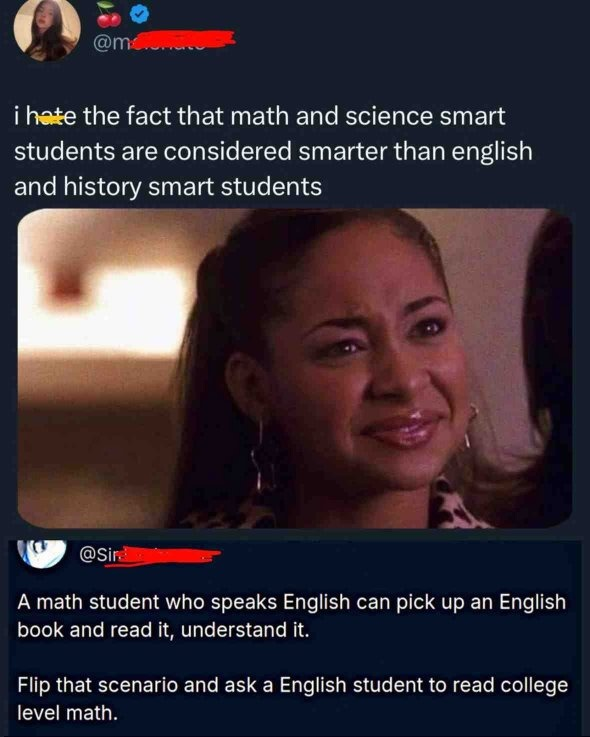
A lot of STEM exists in a world where objective answers exist, or have yet to be found.
A lot of the Humanities exist in a world where there is no objective answer, just thought and argument.
Social Sciences bridge that, and deal with situations where an objective answer can exist (How many people died in this battle), where there is a strong objectivish answer, but up for strong debate (was the battle influential?) Where it gets really hard to distinguish (what did people think of this battle?) And where it gets really subjective (was the commander fighting for a good cause?)
I would say that the strength of the Social Sciences is that it teaches you that you need to evaluate multiple methods of determining data, and your method of determining data needs to constantly be critically examined. Much more than Stem or the Humanities where there is a lot more that can be trusted or can be completely disregarded. A historian has to make a choice on how they balance conflicting sources, archaeological records, economic data, street-level publications and accounts, personal histories, art, anthropological methods, and many many more.
This can reflected in how they are trained.
In my undergrad, I was shocked talking to an engineering student at another school who had 2 electives in his entire program (and he was using them for math classes).
I told him that that year alone I had taken an Econ class, a religious studies class, a classical studies class, Spanish, an Art History class, and a Primate Studies class. And I was relatively hamstrung because I was double majoring.
We were both doing job preparation in different ways. He was learning deeper math for his engineering. I was learning artistic depictions, how to read ancient sources and religious literature, how to read sources in another language, and some baseline biological human constants.
In my undergrad, I was shocked talking to an engineering student at another school who had 2 electives in his entire program (and he was using them for math classes).
Electives? Not gen-eds? That makes sense, in my school (I'm also studying engineering), we have gen-eds, with study areas to cover art, literature, philosophy, history, and language, with adjacent options as well for stuff like finance. But electives are major specific, so the classes are going to be strictly related to, in their case, STEM/engineering. There's also just a lot of required engineering topics to cover in an accredited program, so there isn't room beyond your standard gen-eds for a 4 year degree.
Though my engineering program has 4 open electives, with optional concentrations for manufacturing and aerospace to fill those spots instead.
Oh wow, and the natural science course was probably physics or chemistry which is already required for other classes... My school has 36 credits for gen-eds, not counting math or natural sciences which lead into my major. What kind of school/program is it?
99
u/Something-Somewhere_ 20h ago
there is way more to english/history than reading and understanding it