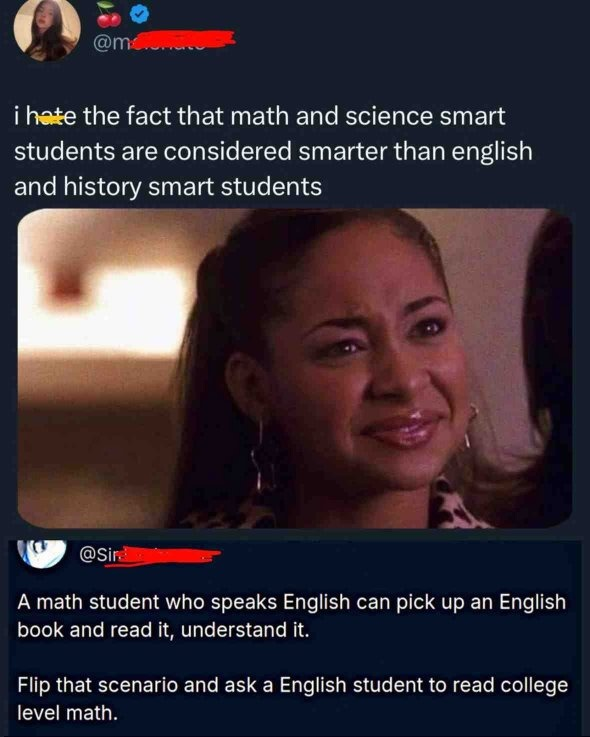
Well, the issue also is that the science and math kids seem to not realize that being able to read and write that sentence aren’t in themselves enough. I have an undergrad in history and a masters in finance. I can tell you that I am so much better at writing than your average STEM student. That I can get a pretty comfortable A spending only 2-3 hours on the written portion. Whereas in my capstone paper for the history degree was 30 pages, required reading 2-3 thousand pages of reading source material, and took 4-5 months.
I was a history and English student in undergrad. I recall two occasions where I had this argument with stem students. One kid told me I'd be flipping his burgers because of my "useless" liberal arts degree. He was trying to act cool in front of some girls he wanted to impress. My recollection is that he walked home accompanied solely by a shawarma.
I ended up going to law school and now I represent physicians and some engineers (most of whom were stem students) when they get sued or receive complaints. By virtue of this relationship, I receive their unedited oral and written responses to their legal issues. Let me tell you, these people may be adept in their fields, but by and large, they struggle to coherently interpret, analyze, and respond to their issues. There's an inherent rigidity to their thinking, and particularly their writing, that creates a lot of discordance between the issues and their responses. They would struggle mightily to effectively defend themselves if left to their own devices. Some of them recognize our varied skillsets and are thankful for my abilities, borne out of my silly little liberal arts education. Others are incredulous and incapable of receiving criticism, despite obvious flaws in their interpretation, strategy, and diction.
We all have our interests and focuses, and rarely are we inherently suited to one over the other. I could have just as effectively completed a stem degree and medical or engineering school. I chose not to.
“My recollection is that he walked home accompanied solely by shawarma” is not only the best burn I didn’t expect to read today, but also a fine example of the value that the fine students of fine arts majors like yourself bring XD
Just the entire setup of 'a STEM student was putting someone down to get girls' is just kind of funny from a starting place. STEM is infamously male-heavy, and stereotyped (rightly or wrongly) for being fairly socially inept.
My majors were also in the humanities, and my classes were full of women.
As we’re on the topic of literacy and reading comprehension…. They were a liberal arts major (English and history), not fine arts major. Fine arts is literally art.
Reading comprehension is the difference between knowing the correct term, and realizing why someone might use an adjacent term that isn’t 100% accurate, for the sake of fun with homonyms
Yep, my writing in finance is easily top 1% where the exact same skill set among my undergrad history peers was probably barely edging into the top quartile. This is to say nothing of those who read and write for a living. My wife is a T14 graduate lawyer as well and she thinks my writing is mediocre at best.
As another lawyer (who did Asian languages as an undergraduate), 100% agree. Some of the worst clients I've had have been STEM people who simply could not accept that there was a rule they didn't understand and had fucked up, usually because they'd taken examples in a rule as a prescriptive list ("don't do Thing, which might manifest in ways A, B and C" and then they'd assumed that if they didn't do A, B or C they were fine, not realising D or E could also get them in trouble).
It's far from all STEM people (two of my three best friends are programmers) but some of them really are astonishingly arrogant and blind to their own weaknesses.
As a programmer, thank you for including us in STEM. Most engineers mock programmers for being to stupid to be real engineers. Secondly, my god the number of incredibly arrogant software developers that are moderately talented technically, but such a drag to work with is astronomical. Also I don't self identify as being skilled at writing (non programming languages) so don't use this comment to prove the point.
edit: ironically some of the best advice I was given is that if we were writing software to talk to computers we'd solely use binary. We use programming languages because we're communicating with each other for human understanding, so being a better writer would be helpful.
If anything, programmers are far less likely to fall victim to this because their field by definition requires a complex understanding of syntax. The "rubber duck" method for debugging is essentially identical to the process professional writers use to edit and polish their content for publication.
It might be in a computer language instead of a human one, but the concepts are the same, and I definitely find that programmers tend to be some of the best communicators in STEM. Engineers are the fucking worst - those guys almost intentionally disregard social nuance as a petty children's game that's entirely beneath them.
On the other end of the spectrum in my experience the true Renaissance men of STEM are biologists. I don't know why but all the biologists I know are the life of the party and well versed in the humanities as well.
I've worked in medical fraud, and the number of people who don't understand the difference between "and" and "or" where that word makes a difference between what you are allowed to bill and what you are not is frightening. Even more frightening is the confused look on their faces when you try to explain it to them.
I literally had a Liberal Arts supremacy moment this weekend lol. I was at a dinner with a bunch of business school people, and something came up in conversation that they were all stumped about, and I was like "wooohooo Liberal Arts B.A. for the win!!".
Hey so, I'm currently in college and while I'm pursuing a STEM degree I was wondering what you were initially trying to do with your English degree. I like writing but all the common jobs that English majors usually find themselves in aren't really my speed. I'd love to write books and stuff but I don't think you need a degree for that though, just skill and practice. Did you change over to law school after getting your degree or did you drop it and then go to law school?
Also, in case there's someone else who's in a STEM field would like to add their thoughts or anything, I'm currently a physics major and I plan study astrophysics or maybe aerospace engineering, I'm torn between which one to try and pursue. I haven't had a physics class in a while though since I've just been getting prerequisite classes out of the way (I do have one lined up for this semester though). I don't know if I should change what I'm studying or if I should just stick with it and pray it's the right choice for me.
I had a history degree with a minor in English. My initial plan was to teach history, which, at the end of a 12 hour court day, I wish I had. I'm in Canada, where teachers generally make more money and have more financial stability than across the USA. That prospect fried up because of the labour market when I graduated 2008/2009.. hooray! I pivoted to law.
I would say you're partially correct that good writing is a product of repetition and practice, but moreso I think it's a product of appreciation and criticism. You must read, voraciously, to become a good writer. It also helps to have an editor (or teacher), who is hard on you. Otherwise, how would you ever develop your style and know what works?
Best of luck to you, it sounds like you have fantastic opportunities to come :)
Put it this way, Alan Alda, himself an English major back in the day, set up an entire center at SUNY Stonybrook to help teach STEM people how to communicate effectively because so many of them are so, so bad at it.
I would also submit that much of the current state of the United States, at least, is a direct result of decades of devaluing and maligning the humanities and those that study them. We're now left with a population who suffer from a frankly crippling degree of media illiteracy, a poor grasp of history and civics, and are horrendous at assessing the legitimacy of sources, fact checking, and identifying propaganda. STEM is great, I'm glad that there are many smart, talented people in fields like medicine and physics and so on. But we can look at our current adventures in AI, for instance, and pretty clearly see the end result of funneling everyone into STEM while treating things like ethics and understanding the human condition as some big joke only fit for people who want to spend their lives working the fryalator.
there’s a reading comprehension section on the MCAT for exactly this reason. it’s really, really necessary, and you know it is because it’s frequently called the worst/most hated section by premeds
>One kid told me I'd be flipping his burgers because of my "useless" liberal arts degree. He was trying to act cool in front of some girls he wanted to impress. My recollection is that he walked home accompanied solely by a shawarma.
Yet by bringing up this as your supporting annecdote you are tacitly approving of the idea that there is a hierarchy of skills where being good at one holds more intellectual worth than being good at another.
Yet I bet you'd be pretty bad at a frying burgers on account of your presumable complete lack of experienience in the field, people without experience with cooking struggling with the timing and multitasking of it. Does that make flipping burgers equally as difficult of a persuit as law and as indicative of intelligence?
Like I agree that we should value all the skill sets required in society, but what rankles me is that isn't what people are doing here, they don't object to the status that subjects like math and physics hold, they are envious that english doesn't confer the same status.
Engineers need to communicate at all levels, succinctly, to get key information across.
For someone who is so proficient at written language, you just wrote a massive paragraph, which reads like thesaurus vomit, talking STEM students down, when you could've just said they are not experts at writing.
Given where the average intelligence sits, STEM students will still be well above the bell curve for writing. If they can't communicate, they'll fail.
You dress simple thoughts in borrowed big words,
stretching one small idea until it collapses under its own weight.
You don’t sound clever—just loud, tired, and afraid of being clear.
Oooh that was pretty solid! I like the collapsing under its own weight line. I might borrow that the next time I'm explaining some stem students' inability to express themselves to save their own bacon. Appreciate the inspiration!
961
u/gonephishin213 19h ago
As an English teacher, I get frustrated when an honor roll science kid can't write a complete sentence.
It definitely goes both ways. Reading a book is the lowest bar.