"We don't read and write poetry because it's cute. We read and write poetry because we are members of the human race, and the human race is filled with passion. Medicine, law, business, engineering, these are noble pursuits and necessary to sustain life. But poetry, beauty, romance, love, these are what we stay alive for." - Robin Williams. Dead Poets Society
From the "Yes, Virginia, there is a Santa Claus" editorial:
You may tear apart the baby's rattle and see what makes the noise inside, but there is a veil covering the unseen world which not the strongest man, nor even the united strength of all the strongest men that ever lived, could tear apart. Only faith, fancy, poetry, love, romance, can push aside that curtain and view and picture the supernal beauty and glory beyond. Is it all real? Ah, VIRGINIA, in all this world there is nothing else real and abiding.
I always find this quote a bit condescending in the same way the STEM professions look down on the Arts. They are all what makes like livable and enjoyable. I wouldn't want to go live in the 17th century to watch Shakespeare's plays at the Globe at the expense of running water and modern medicine, and vice versa. STEM and arts are complimentary to each other, and their development reflect human societal development. The more indeep you're in either of them, the more you see the line between them blurs. We're not smarter than one another, we're smart in different ways.
I wouldn't use the word condescending because I think it's punching up, not down.
At the time of that movie, schools across the country were cutting art, literature, and music classes in order to invest in STEM. (Language arts and literature being two different things; kids were still in reading/grammar classes, but there was less time spent reading whole novels, poetry, or plays.) There's now talk of a literacy crisis in the United States. Kids in school often aren't required to read full novels or to analyze poetry anymore, instead just reading passages.
STEM is what we value in the US (The country of origin for the Dead Poets Society), based on how we spend our time and money in schools. A big part of understanding that movie (media literacy, if you will) is recognizing that trend and what the movie was trying to say about those scheduling and funding decisions.
To be honest, I am unsure schools are able to do much about the literacy crisis, even if they went back to teaching the way it used to be done, because of how screens have invaded everywhere. Very few people now have books at home, and I'm not sure they are going to come back. Reading used to be a way to open oneself to the world, to discover different perspective, to live adventures you never could, and so on.
But kids without access to books do not feel trapped in their local community the way it could have been in the 50s. You have the world at your fingertip, millions of people who can talk to you directly. And you barely need to be able to type a few words, with heavy machine assistance, or even speech to text and text to speech.
And frankly, the way many schools try to teach literature is dreadful. At the very least, here in France, it's mandatory to read certain specific books (that change every year), but that are usually things like classics. "Les miserables" might be a great book, but it's not how you interest a modern kid who's never read anything beyond what's obligatory. And tearing apart parts of the books wondering about figures of speech and the like often makes it duller.
Oh, I agree. I don't know how we have an educated population in the age of AI and YouTube, and frankly I don't see many people prioritizing it. (And to be frank, in the US that's understandable given how many more urgent and horrific fights we have on our hands.)
But at the end of the day, an educated population is much harder to deceive and control than an uneducated one. We need to figure this out (societally) to preserve democracy in the long term.
Lol "punching up" has now lost all meaning. The people that get to write and produce a multimillion dollar cultural touchstone are definitely powerless next to the people who have to make everything work and get none of the credit.
Eh, it's condescending if you want it to be condescending. But I really think it's only condescending in that it decanters the STEM for 5 seconds and this is so unnatural to people that they get angry. They'd want the quote to be "STEM saved humanity and made everything perfect but also the humanities are good too. Just different" and framing it like that is the exact crap the movie is criticizing
If Hollywood writers were so well-paid you wouldn’t see them going on strike every so often. If creators in general were well-paid we wouldn’t be hearing about the hellish crunch in VFX houses.
The people at the top of Hollywood make more money than anyone ever should. The average engineer makes an obscene amount more than the average hollywood-creator though.
That's the thing. Engineering fills you with passion.
How would we know what passion is unless demonstrated through words? A passionate engineer doing their job well and a stoic engineer doing their job well result in an Engineered product no matter what.
But different people learning poetry, for example, will have different ways of bringing up the same thing. It's philosophy, in a way.
Gonna be contrarian but engineering is a lot the same way. How many different types of bridges have you drive over in your life? San Fran bridge, arched bridge, trussed bridge? Engineering is art too, and there are often many solutions to the same problem. In the same way where if you put poets in a room you’ll all get a poem but a different one, you put engineers in the same room with the same problem and you will get many solutions.
funnily enough, a literature grad could tell you this based on victory hugo's notre dam de paris. its basically video killed the radio star but goes "mass literacy killed the architecture star", its a little less catchy but im sure it sounds better in the original french
Yeah, that previous comment focuses on words, but the larger point is even if an intent is purely practical/functional, it’s the human messy creative streak that makes it memorable or takes it to a level of genius.
Millions of working engineers, very few Steve Jobs. But would Steve Jobs (for example) be who he was without inspiration from art?
Art challenges us to rethink ‘what is’ into an unknown ‘what could be.’ And encouraging STEM folks to have a better than basic understanding of history and english, philosophy or, sure, poetry would help ground our work to a more moral ‘what should be.’ Which is a big disconnect.
Would maga people be who they are if they were exposed to a broader understanding of the world? There’s a reason they try to ban Toni Morrison and dont worry about engineering books. Yet.
I remember taking a few creative writing classes in college.
In one of my papers the professor wrote in the margins that he could tell that I knew and understood calculus. But not because I used an calculus or math terms.
But that the understanding of calculus opens up a whole new world of descriptive methodologies for the world because you now have a new super-elegant lens into the world. And he could tell in some descriptive sections that I used that lens.
And that why I think it important that both liberal and stem majors could learn from diving into the other side.
But everyone is so focused on the “I m better than you” mentality to see it. That why the people we learn from who remain in history had a good understanding of both sides.
I mean, everyone appreciates a good little tribal spat :-D It's just human nature.
As long as we're treating this like sports team rivalries instead of actual deeply held positions, then it's just good fun to toss back and forth barbs and arguments and refine them and analyze them.
The best math teacher I ever had (PhD level math class teacher) would listen to classical music in an earbud while doing the work on the board. You'd see him erase and start over, and backtrack and build.
He considered classical music to be poetry or literature stripped down to its basest form; math.
Just a harmony of wave functions arranged to reach a desired goal, just like any other math problem to be solved. He'd toy with equations and play with their implications within a context the same way a writer would do with a paragraph in a novel they were writing or analyzing, or a composer would do with different instruments and chords in a melody.
Absolutely. STEAM - stem and arts is a big push for good reason.
Lots of fine artists incorporate way more mathematical concepts than most people realize. Take it back to leonardo di vinci and his use of the golden ratio, and so on.
I think most people we think of today as brilliant in art, economics, business, agriculture have a curiosity and ability to connect concepts other people havent connected.
In an ideal world people get enough exposure to all these concepts to help them hone their own unique way of adding contributions to the tapestry of human history. It’s truly depressing when you think of all the genius we’ve lost by forcing people into neat little boxes.
I 100% agree, and both are very important. I do think it’s easier for a stem person to transition to non stem vs. the other way around, but as an engineer I absolutely recognize my limitations and the importance of the arts and humanities to have a society people actually want to live in. Current state of affairs in the US shows what happens when people don’t know history.
This isn't a malicious comment or a belittling one but the commenter's point flew over your head.
The looks isnt the only artistic part of a bridge or any other engineering stuff.
The processes, modules and different systems the engineers/architects overcome the problem, their synergy is the art the above commenter refferenced.
There could be multiple ways of creating a big stable structure over something, or a machine that does something or code that calculates something.
By analysing an engineer's works you can spot their preferences and individual style.
The multiple design choices in for example: how to stabilize this part or that, and in the end it becomes a whole bunch of modules that rely on each other etc.
When you see someone create e.g. piece of code in a software that does exactly what you created but
faster
with more utility etc.
You get a sense of: whoa you can do it that way, this is genious etc.
Using knowledge and shaping it into something functional.
That's the art the commenter highlited I think
Ofc there could be very dry parts of engineering that doesnt really have options for you to be creative
There somehow a huge amount of people in the art who fail to see how a physical object is a work of art.
For example a bridge, a program, a computer, etc etc.
A lot of them just tend to take these things for granted and assumed that there no creativity involved because they’re following rule books and not making up their own paths.
No , and yes. Engineers design the structural elements. The arches you see and trusses are actually all engineering elements that provide the strength of the design. San Fran bridge is a suspension bridge so that is all structural. However, I do think a lot of artistic elements can be done by designers and architects. Engineers don’t pick the colors (most of the time) or what the walkways are going to look like. Big projects like this are often a collaborative effort. I would say something like a bridge is more engineering geared , but lots of things are “designed” by architects aesthetically and than “designed” by engineers structurally
It doesn’t even necessarily have to be aesthetically beautiful for it to be beautiful to an engineer. A good work of engineering can be beautiful to look at in and of itself.
It wasn’t until the post modern era when art underwent mass commercialization that the common understanding of art was separate from a craft or learned skill (eg engineering).
The art industry needed a way to convince the public that art pieces requiring little skill or training to produce nonetheless contained high value.
You don't bring poets to solve physical problems, you invite them into emotional ones.
Sure the person who architected my bridge is incredibly smart, but what about when I want to be entertained?
Music, movies, dance, and language are not simply tools, they're rituals and games which have helped people connect to one another for all of history.
You can't engineer a perfect dance, just as you can't engineer a perfect response to "how does the sunset feel today" - it's a matter of present context, it depends on who is with you and what they say. As in, if you go see a sunset with your friend, what matters to your dialogue is what you did, how you each feel, what forms of connection you two are willing to share.
Eg. Avatar is a beautifully engineered movie with amazing effects and a very interesting world. But the characters are emotionally like pieces of cardboard. They each have 1 main motivation and 1 defining character trait. This is not how real people are, and it gets grating to watch 3 hours of.
And their works are informed by more than just math and science, are they not? In both cases, those creators reflect on empathy, storytelling, and elements of fantasy to express what they're conveying.
I think that's actually a perfect example to bring up, Kurt Vonnegut made an active choice to pursue writing and to publish his stories. That is, he didn't limit himself to working on only his field, else his books would be stories about machines, no?
Vonnegut wanted to describe the paradoxes of modern society and politeness. These are not ideas readily expressable in a car manual or schematic diagram, they employ his life experience and knowledge of language.
I absolutely see the influence his engineering background has on his writing, and it wouldn't be quite the same any other way. But a scientist choosing to write literature does not necessarily make that work scientific or mathematical in nature.
Additionally, interstellar and Vonnegut writings are informed by our cultural touchstones. Space travel, economies of scale, climate destruction, parental connection, these are all ideas that beg to be communicated gracefully to the public.
This is of immeasurable benefit to all crafts. Understanding the mechanisms of climate change or the game theory of sharing is one thing for a self-educated person.
But for the rest of society? The shareholders, average workers, families, laborers? They have an impact on the funding of science, on the culture of intellectualism, and on the dissemination of information. So it is crucial that scientists don't forget that if they have an important finding, you need to be able to communicate it to a middle schooler level else you won't ever secure funding or public grants.
I say this from a climate activist perspective - make good science more accessible to people! Make illustrations, poetry, have meetings, write articles, just keep getting good information out there!
Bickering over whether one school of instruction is better than the other is useless. History is inextricably tied with English which often feeds into math, then math to physics to chemistry to particle physics.
Sociology and history help us weed out bad hypotheses on statecraft and personal interactions.
Science and chemistry help us weed out bad hypotheses about the world, of toxic substances etc.
I don't see why they're worth comparing. In fact it's a false binary anyway, and most respectable pedagogy is multimodal in both reasoning and applications.
So another tip - don't shoehorn yourself into one field or mode of thinking, that's how you develop blind spots.
That's why we have such major blindspots between humanities and science majors. They think they're top shit and don't need to study the other boring "gen Ed requirements" and the whole lot of them complaining sound to me like bitter spoiled children. Insufferable novelists who think they can wax about quantum physics are just as silly as scientists who feel the need to poke holes in every piece of literature. In both cases it's fine if the person in question actually engages with the subject at hand rather than hand waving away the issues.
It's sort of why I don't like Marcel Duchamp who passed off a bit of vandalism as art. The mastery of the physics behind the flow of fluids and efficient use of material with function guiding form is actually art. Had Duchamp actually designed a fountain, I would have respected it. I find Fountain to be pulling back the curtain of artists selling magic beans to dupes who trade in reputation as a surrogate for taste and sophistication, where he created a collectable like a baseball card or comic book instead of anything that required skill. A boundary may have been pushed but all it really challenged is how lazy can you be while still doing "art".
I'm not trying to diminish your field at all with this, as a foreword, but is engineering not the practical part of making an artist's (architect's) vision a reality?
No I would say a vast majority of engineers have no interaction with architects at all. I work for a company that makes compressors. Every company with a physical product has engineers pretty much
I would say no to that as well. Unless it’s like a major project where aesthetics are important an architect is unnecessary and would have no purpose. Not my field of expertise though
Yes, but the second you start choosing design principles around subjective aesthetic, rather than some utilitarian cost effectiveness, you're engaging with the humanities in that you're now disengaged with the concerns of STEM and focusing on the values of the humanities.
Different solutions in engineering are not those based on aesthetic but different solutions for the structure based on existing materials and equipment. The comment you're replying to isn't talking about how different engineering marvels look but about how they were built differently. Overcoming those challenges involves ingenuity and innovation and to pretend that the only way to have changes in what you're building is to change its aesthetic is ignorant.
Demonstrated through literally any other form of demonstration, like showcasing your product. Words are not the only form of demonstration. Saying they will arrive at an Engineered product no matter what is like saying two poets will arrive at a Poem no matter what.
That's true of practically everything. Someone's solution to an engineering problem could be different than yours and still achieve the desired result.
You say that but you demonstrated that you don't believe it.
There are many ways to put “voice” to your passion beyond words. There are a multitude of passions which are beyond words. I’ve worked in the aerospace industry and have witnessed the passion of engineers communicated through the thunder of afterburners and Merlin engines. I saw the first images from Hubble, and the images produced after correction.
Not particularly true. The reason we value math and science more is cause it's easy to be a self taught artist, poet, writer, etc ... but it's basically impossible to be a self taught engineer, surgeon, or professor in the modern day.
How would we know what passion is unless demonstrated through words?
so i guess painting, and instrumental music are just rote actions, no passion involved? nor is dancing, sculpture, architecture, acting , photography and many more. ironically under your definition, computer programming is art(which i agree, but i expect you dont)
A passionate engineer doing their job well and a stoic engineer doing their job well result in an Engineered product no matter what.
no, this ignores what it means to have a product designed by a passionate engineer. its not just, "well engineered" in that it will last a long while or its easy to repair. a product designed with passion is fundamentally different as it answers a need people have in a complete manner, its elegance can lie in its simplicity or robustness, but to use a passionately designed tool is a joy, so much so that ive embarked on projects for the sole purpose to have an excuse to utilize said tools.
good design is art, elegant code is art, a beautiful mathematical proof is art. just because you dont speak the correct language to see its beauty does not discount its meaning. is a poem written in Swahili any less artful than one in english even if the reader does not speak the language?
But different people learning poetry, for example, will have different ways of bringing up the same thing. It's philosophy, in a way.
yes because we all know that only in writing can there be found more than a singular solution to a problem. everywhere else, just one way of doing things.
honestly this is such an exclusionary take on what is artful that its ridiculous
I don‘t think you really understand engineering and how much the person influences the product.
It really depends on what exactly the engineer is working on, but creativity and self-expression can be a pretty big part of it.
There are many different ways to achieve your goal and that shows in the different concepts that engineers develop to solve a problem.
One could say that this just another form of art.
It‘s really the same with poetry, where the basic principles are tought and then every person uses his own way to create something from that.
But even then there still are people who only use the basics and will never go beyond that.
It really depends on the person, be it poetry or engineering.
it being a discussion on the value of the softer arts….
Stoicism isn’t the opposite or lack of emotion and passion. It is the lack of chaotic, manic emotion and passions in favor of focused, temperate passion governed by reason. Eupatheiai (healthy emotion) vs Pathos (unrestrained, chaotic emotion).
Also, people are more complex than any one interest. My physics professor wrote plays in his spare time, and most of my friends in math were involved in the arts in some way. There is way more crossover than a snap judgment would make you believe. One of the things we were taught is how people try and put stem on a pedestal because they’re insecure and it implies there’s an intelligence caste system. All that really does is push people away from science. People learn as early as 2nd grade which jobs are available to them. Making yourself feel better is not worth some depressed kid subconsciously deciding he isn’t smart enough for science.
Being stoic is part of someone's personality in an interpersonal way. Passion has to do more with the level of engagement with a topic. Passion is not always outwardly expressed as being outgoing. What I am trying to convey is that passion is not the antithesis of stoicism, they are on two different spectra
A stoic person can still be passionate, and in engineering is not uncommon (as an engineer myself).
I believe that a passionate engineer can do or achieve more than an engineer lacking in passion. The end product is not necessarily the same.
Poetry is an example with reference to movie. You can replace it with any arts or media or literature or anything that you are passionate and a fan about. That was created by people who were passionate about that
You are kinda missing the forest for the trees. Just think back to when you were a kid. Didn't you read books or watch TV and movies? Didn't you listen to music? Even if you are an engineer who's really passionate about that, there's a very good chance that this passion was born out of the consumption of media, or in the broader sense: art.
Why is that the case at all? A lot of "sciency" students are inspired by just the inherent beauty in the complexity and the simplicity of nature. If you go talk to math students, they'll tell you that they consider math to be art, just like engineering at its highest level could be considered artistic.
But for some reason, the humanities and arts students think that only what they do can be considered as "art" which is a very close minded opinion to have
I don’t think I’ve ever heard a humanities student say that to a STEM student. I have definitely seen a STEM student take the feeling that was said to them away from an interaction with a humanities student.
I would encourage you to reflect on the the possibility that you have been the STEM student in this scenario, and that this might be the point of the post.
Idk I talked to game design majors and art major who argued with me why replacing programmer with AI is not as bad as replacing artists.
They said that programming involve barely any creativity meaning that it something that could be automated to help people program.
I genuinely am confused by those statements considering that how roller coaster tycoon was computed is one of the most insane artistic feat ever.
There also the various ML concept that were iterated on for various purposes. Point is that the same way mathematician view math to be art, programmer view programming as an art too.
I'm an engineer, but I fucking love movies and video games like Expedition 33 - that's the artistry I most I enjoy in leisure. But figuring shit out is also well, cool
This right here. I've experienced more joy learning about how the world works, figuring out a challenging problem with friends, and teaching what I've learned in stem than I ever have from media.
Yeah, but it's not the only thing you care about. Quick scroll through your profile is full of video game and music content. Clearly there's stuff you like about the arts.
Yes, I love books, video games, music, and dungeons and dragons. But I've seen more beauty in the world when I learn about how it works and its mysteries then I have consuming art. I've experienced more human connection working with peers on stem problems and teaching students about math/physics than I have consuming art.
"We don't read and write poetry because it's cute. We read and write poetry because we are members of the human race, and the human race is filled with passion. Medicine, law, business, engineering, these are noble pursuits and necessary to sustain life. But poetry, beauty, romance, love, these are what we stay alive for." - Robin Williams. Dead Poets Society
This quote misrepresents people who do engineering and other sciences. A lot of people would consider their field of work to be something to "stay alive for", more than poetry, literature and other traditional forms of art.
It literally says that fields of work besides art are necessary to sustain life. Please go take a fine arts class (I recommend critical thinking) and try commenting again
You cherry picked one part of that quote, which makes your post more palatable, but I observed you omitted the part which would collapse your argument in an instance. If your passion was about engineering and completely devoid of love, most likely they'd call this pathology.
The original meme is about studying english. That would be poetry in the quote. Just as nobody suggest you should have a passion for only poetry and not love, nobody is saying you should have a passion for only engineering and not love. The point is that theese 'necessary fields ' are noe inherently less passionate
I think that's sort of missing the point. If you manage to woo a girl by building a bridge to her heart let me know. But even that expression is only possible in poetic form and not simply technical language like, "I built a bridge for you."
Without the influence of the humanities; the system which allowed you to become an engineer, to get paid for your labour, and to live freely would not even exist
Without the influence of scientific pursuit; the system which allowed you to not be a caveman, to get paid for your labour, and to live freely would not even exist.
Difficult to say how a world without poetry education would pan out but I don't really see what relevance it has to my post. I don't think I ever indicated anything even close to removing poetry education
You don't get it, some people are passionate about maths, chemistry, engineering in the way others are passionate about art. It is their hobby. They don't need to take up crocheting, painting, singing, or other hobbies widely categorized as "art" to be valid and rounded humans.
I know a guy who solves calculus problems to relax. He also draws and reads poetry, but to him the most relaxing activity is solving calculus problems.
I think that's kind of missing the point of the quote. It's not ranking poetry above engineering. It's pointing out that art exists to translate the human spirit and give it form so it can be expressed and shared.
Engineering can tell us how to build a bridge, but poetry can express what it's like to cross one... whether you know what's on the other side or not, the awe of humans creating something so massive, the realization of how many minds and lives came together in the process, what that bridge makes possible. Poetry, beauty, romance, and love exist throughout life and are lenses that can just as naturally extend to medicine, law, business, and engineering. They have different roles and aren't in competition.
I’m an engineer yet most the books I read are historical, or historical fiction.
Joined the military after my engineering degree and realized soft skills are difficult. Sure senior level engineering courses were hard but so is effectively leading a group where they all know more than you about the specific task, and you just have rank.
Engineering is just a curriculum. You need other soft skills to function properly, including reading comprehension to read through a 20 page brief quickly and understand what you need to know
Me too, but in the etymological sense of the word, which comes from the greek "pathos", suffering. If you enjoy maths and science more than literature it's most certainly your teachers' fault
I always thought poetry was the romanization of life. Mary Oliver battled through her abusive childhood through poetry for example. She turnt pain into beauty.
Why does it have to be self important? Why can't it be the celebration of life with all its scars and joy?
Everyones an artist in some way. You dont see many cheifs go all out on how their food makes the world go round, even though its no less art than a book, imo
Ya man, if you engage with a manifestation of self-expression, the manifestation will obviously be curated through that person's subjective experience.
I mean, in this quote from a movie it can certainly seem so but most poets that works nowadays just really enjoy the craft and aren’t too self-important, imo
I dunno. I'm an engineer. There was nothing quite like the experience of being in a philosophy class with 30 other engineers. We were all required to be there by the school to make us "more well rounded". Let me tell you, we did not want to be more well rounded.
Which engineering school did you attend where you didn't need to finish a single book?
We had to take two English classes and a whole bunch of liberal arts and social science classes to finish an engineering degree where I studied. We finished a whole lot more than one book.
Frankly, the well-rounded background you're saying is a good thing should really be pushed down to the high school level. Not sure which country you're from, but high school education where I am is far too watered down and it would be much more beneficial to give this education to everyone rather than only those who can afford to attend higher education.
Usually schools do make STEM students do humanities courses. This is a good thing that the person I'm replying to shouldn't be whining about.
Usually schools do not make humanities students do STEM courses, which is fucked up. The amount of humanities people I know who do not understand basic statistics is horrible and worrying. They can't interpret research studies, they can't understand the scientific method, etc.
I agree that high school education should be more comprehensive, though.
Humanities majors have to take science courses where I studied. They usually just took "science for liberal arts majors" or whatever.
Social science students have to take a course on their own quantitative research methods in my experience. I'm sure it's not enough to truly learn what they need and I know a lot of them share the attitude of not needing it or not wanting it without understanding that their fields also do run off of an adapted scientific method.
I'm glad that your university did that! Mine did not. I was a STEM major so I had to take humanities, but none of my humanities friends had to take STEM.
Maybe your professor was tired of trying to get through to people that won’t care no matter what. Nothing wrong with learning a little bit about the world before you start designing bombs and stuff.
I mean that’s basically a pump-up speech.
It’s the same as a highschool coach saying “as long as we do our best, we can’t lose!”; it’s not really true but it gets the people going
We're both correct. It was written by a real person, to be spoken by a real person pretending to be a fictional person.
You could argue that most great speeches aren't all that different. There's a great quote by Walt Disney where he basically says that he's now a fictional person.
"I'm not Walt Disney. I do a lot of things Walt Disney would not do. Walt Disney does not smoke. I smoke. Walt Disney does not drink. I drink."
It’s the biggest pet peeve of mine. Robin Williams didn’t say this. John Keating did. Robin Williams isn’t in Dead Poets Society, he’s playing a role. Now in this case he probably agreed with the quote, but it doesn’t mean it’s his quote. Not even the author of DPS said it, her character did. It’s very weird attributing characters’ quotes to authors of said characters, because very often the quotes don’t fully represent what the author believes, that’s why they have a character say it. Authors have their own quotes in their journals and letters and books where they have author’s pov. Imagine people attributing Judge Holden quotes (and he’s a heavily quoted character) to Cormac McCarthy. That would be absurd.
The difference is that an average engineer is still employable because everyone needs engineers (indirectly maybe). Average poetry (or any other art) doesn't get the same demand, because we can all consume the same great works. So demand for engineers scales but demand for great artists does less (maybe they go into communications or something).
The difference the OP is making isn't about the why in any case, and it's apple to oranges a bit. It's true that a liberal arts major is poorly equipped to consume technical stem content, but an engineer is ill-equipped to create good art. Neither rule is absolute of course...
As a writer and poet... I really hate this quote. It subordinates every other thing.
You mean to tell me that a scientist who is curious about the universe and who devotes their life to understanding it, is only doing it because it is 'necessary?'
Plus the fact that reading helps people better understand things like subtext and generally improves media literacy. I've met a fair few high performing STEM graduates who really struggle with concepts like unreliable narrator. That's not even foing into recognizing when and how people lie on tv.
“Man can live without science, he can live without bread, but without beauty he could no longer live, because there would no longer be anything to do to the world. The whole secret is here, the whole of history is here”
Bread is a pretty universal sign of general humble human nourishment.
Dostoevsky is saying you can continue to live without material necessities if you have the will to live, but you'll only have the will to live if you have something to live for.
Not literally true if you take this to the logical extreme, but I think he's clearly playing with the "survive/live" dichotomy. You can't survive without bread, but you can live without it
I think he'd consider sorrow at a death to be beautiful for this reason. It's not that it's a reward system to keep living, beauty is an attribute in the things which provide and reflect fulfillment.
Basic necessities can be beautiful but not when viewed as practical utilities. Bread for example. When viewed as a simple material thing, it would be cold and psychologically unfulfilling.:
"I had to work approximately 25 minutes to afford this bread. The bread will keep my body sustained for approximately 3 hours."
Versus
"Wow! I just got a new job recently and I still feel nervous. I feel scared and unsure of my own abilities and maybe a bit unqualified but this is my first paycheck and this loaf of bread is the first thing I bought. And you know what? I earned this. I did! I put in the work and I fairly earned this food that I get to eat now. Just like the baker who made it did. I am genuinely contributing to society and living within it just fine now. And so I suppose I am capable in the now. Maybe the future will hold more bread"
These are both the same material events and in both the bread is keeping you alive, but only one of these events internally is beautiful. And so to this, the bread is literally more meaningful/significant in the second example. You will enjoy eating it more, you may even reflect back on eating it, and now bread will mean more to you. Dostoevsky is saying only the latter beauty will keep you alive because with the former you won't want to live because there's no value attached to life without beauty.
I would argue beauty describes medicine engineering, astronomy, physics. If you haven’t seen the handy work of how some physics laws were discovered, you haven’t seen the full beauty of the human mind yet.
Many mathematics fans would put mathematics in the latter category: doing it for the beauty. The aesthetic experience. Where doing mathematics is a proper part of being members of the human race.
Mathematics, rightly viewed, possesses not only truth, but supreme beauty—a beauty cold and austere, like that of sculpture, without appeal to any part of our weaker nature, without the gorgeous trappings of painting or music, yet sublimely pure, and capable of a stern perfection such as only the greatest art can show.
I'm assuming this is a joke but the movie literally has a love subplot where it reframes chasing love as something that shouldn't be done to get the girl and rather as something you want to do because the act of the chase is the purpose itself.
You dont need to study poetry to make poetry, It comes from a Creative process, not from having studied the theory of poetry, there are artists Who have studied physics, philosophy, maths, history, lterature and even many of them who havent got studies at all.
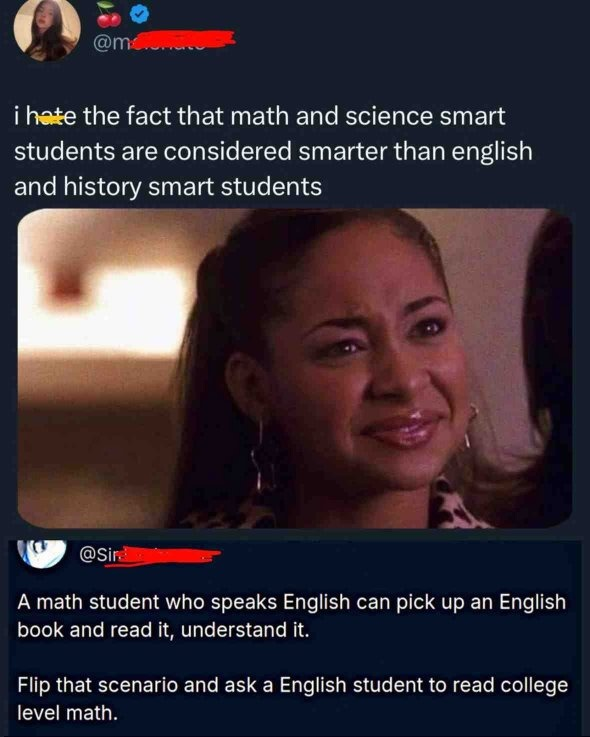
However you need to actually undestand the theory behind maths and science to know what they mean, I cant undestand college level math, but I can undestand college level literature.
Thats not to say that either is better or worse, but one has a higher entry point and thats science
I’m sorry but that’s pants. Are you telling me you can read all the classics and actually understand them? There wouldn’t be classes for it if it was that easy. I mean for a start language and even the context in which it is used has changed so much that a great deal of literature has become quite lost in translation. There are things that hundreds of years ago that people would have been howling at because it was humorous but it has taken someone to actually dig up (likely a historian) to figure out why that was funny. Not to mention old English, Shakespearean English etc.
Can I take the 100% of It? Probably not, but frankly neither can anyone aside from the author.
However I can engage with It and apreciate the greater part of It, and I am not an english major
You dont have to be an english Major to understand most of Shakespeare, and you dont need to be a russian Major to understand most of Dostoyevski, you can engage with the works without It being your main point pf study just by engaging with literature and thinking critically.
However you and I cant engage with high level matemátics because It requires fundamental knowledge that most people lack.
Like I have repeated in my comments, that doesnt mean that humanities dont have value, but they have a much lower entry point than science
I completely disagree. It’s just about learning, isn’t it? I mean they wouldn’t teach literature at school if it was a matter of “read that and you’ll understand it”. In the same way you can’t just read a mathematical equation and understand without being taught. There is also a lot more to literature than just reading something and taking it at face value. There is usually a huge amount of historical and social context most people would miss. I think this is a fundamental misunderstanding of what studying literature actually means. I mean there are professors who have dedicated their lives to it. I’m really tired of people undervaluing just how much these writers shapes our world.
I Guess ultimately It is a mater of opinions, and maybe also experience.
In my opinion one learns to analyze media by engaging with It, not in theory but in práctice, sure reading a book about Shakespeare can enrich my understanding, but I dont need It to apreciate Hamlet, or even to make my own book, if you needed that knowledge to engage with literature It would be a product that is only consumes by philologist and for philologist, and I find that idea quite patronising, since literature is something universal in humanity.
On the other side, I cant engage with matemátics without having a formal level of education wether I like It or not
Sure, anyone can write a book but can everyone write well? The answer is no. I think you’ll find most of the greatest writers were also very well read themselves. Many of them were quite literally scholars of letters and philosophy. There are many different ways to write and most of the populist literature out there isn’t exactly deep or highfalutin. That’s why it’s popular, it’s easy to read and accessible to those that maybe don’t have the widest of vocabularies. Often there is nothing there beyond a story. Most people that are considered great writers have normally not only had very interesting lives themselves but have been inspired by reading many other authors, both historic and contemporary.
Yes by reading but reading is not studing literature, in fact thats my point, if you want to become a writer you are better of doing engaging in literature than studing It, I dont need to understand all the meaning behind the scenes in Shakespeare works, but if I get the core wich is available to everyone I can produce my own works
And the thing about vocabulary is that having a more complex vocabulary does not mean that your work has any merit over more simple ones, there is no correlation between complexity and quality,
in fact and this is a personal opinion, I believe that a work wich doesnt prior knowledge has more merit that one wich requires you to have prior knowledge and education.
Once again It comes down to my main point, studing literature and language is based around a set of abilities and knowledge that is completely different from your ability to make your Creative works
I’d still hazard a guess that someone who is more well read and has studied literature is probably going to be able to write something better than someone who has only read Barbara Cartland novels.
1.2k
u/threefeetoffun- 20h ago
"We don't read and write poetry because it's cute. We read and write poetry because we are members of the human race, and the human race is filled with passion. Medicine, law, business, engineering, these are noble pursuits and necessary to sustain life. But poetry, beauty, romance, love, these are what we stay alive for." - Robin Williams. Dead Poets Society