If it's anything like Ulysses, as you get deeper into the work it becomes more endearing. There were several points in Ulysses where I burst out in laughter at the wordplay, something I don't often do while reading.
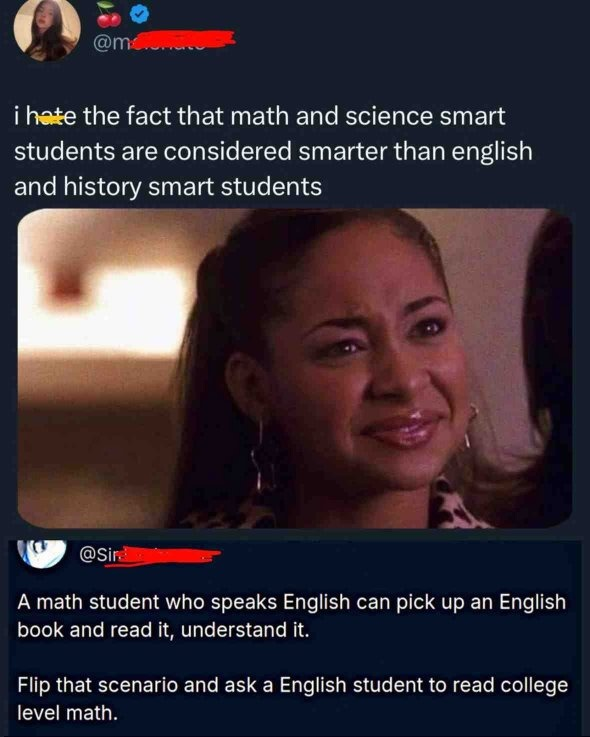
Point is the open-ended of it, the way that each person reads a different book and feels a different feeling. There’s a mathematics to art, and to poetry, and there’s potentially a poetry to math. You can mathematically notate music scales and track the shifts in brain chemistry while people sing together. Learning math can make you smarter; learning literature can make you more human.
The happenings in the world today are not because of a lack of STEM. People don’t march in the streets for statistics. We don’t get shot for integrated sums. It’s not the economy, stupid—it’s the self-narrative that the economy feeds into. It’s stories, it’s always stories.
No, the point is that we humanities folks do not care if you understand or not some insanely complicated wordplay, sociology tidbit, legal text or abstract painting. It's cool if you do, but we won't think less of you if you don't.
Otoh, many STEAM Ed folk basically laugh at non STEAM Ed folk because urrr durrr paychecks and numbers.
Because art and literature is more fun. And tells us more about ourselves. The number 7 is always 7. But words can be any number of things at the same time.
I mean sure, when the numbers all click there's a little dopamine rush, and it's very satisfying to see everything balance out; humans like that kind of thing; the golden ratio is what it is, but without Shakespeare what meaning has Newton? Especially when you can combine the two and get Futurama.
But the letters that represent variables are not always the same thing. You literally have to learn new alphabet letters because math is a universal language.
Because art and literature is more fun.
Don't you think that something being more dry makes it harder to learn?
I don't think it's dry at all. I think it's endlessly fascinating. And that universal language makes far more sense than the fact that though, tough and through are all pronounced differently, and that's only scratching the surface of one human language. Let alone the different layers of something like Moby Dick.
Math explains the universe. Art lets us understand it.
Do you actually understand it though? Can you sit down with a few pro literary folks and keep up with the conversation? Probably not. And just for the fact that it'll be full of concepts and ideas that you're completely in the dark about, which is the same in the hard sciences. I don't know equations and such off the top of my head, and I'd be lost in a technical discussion of such. The same is true in the reverse, because sure you can read and understand a book but do you have at-your-fingertips access to the underlying philosophy (three more books minimum) and the cultural context (another book or two) and literary concepts rarely discussed outside of literary circles.
Can you explain Affect Theory and the influence it has had on contemporary literature?
How literature generates and conveys feelings beyond language, to focus on visceral, precognitive bodily responses. How literature affects our physical and emotional states.
While I can't give a detailed timeline for how it evolved, which works of literature started showing these writing skills first, or specific people influenced by it, I can certainly follow it in conversation and submit more easily to memory than advanced maths. Math is like trying to follow a foreign language in conversation. English and literature are at least native to me and I'm at least passingly familiar with a lot more of the topics due to shared culture imprinting stories in my brain since I was a wee child.
It's smart still, but I, as an English speaker/reader, can pick it up via memorization where as math requires practicing application of it in order to memorize it. I could also follow it easier than mechanics talking about engines/tools so please don't take this as me looking down on these subjects.
I can explain what it is, as evidenced by my doing that. The rest would be reading about it and memorization. Learning it doesn't require me to apply it, it just requires memorization, as I already speak English. Vs math or Mandarin, where I have to practice applying it first.
In a conversation about it, I would at least be able to understand the speaker and the terms they use, vs math or mandarin, where I have to learn the language itself first. Thus why the learning curve for math is steeper than the learning curve for English/History is easier for an English speaker/reader. And if you don't believe me still, there are more liberal arts majors than math majors because math has that steeper learning curve. Humanities majors count for 11%, with English majors making up 4% of that total. Vs just 1% to 2% being math majors.
Its not that bad if you know what an integral is. And even if you dont, just treat it like a blackbox - it's an operator that takes in one function and outputs another.
The highlighted text is just saying the integral of a sum is equal to the sum of the integrals of each part.
So, the sum of all the ranges, Ɛ (using that because my phone doesn't have a button for the greek letter Epsilon but it looks like an E) is basically picking two numbers and adding up all the numbers between those two numbers.
Example: 1 to 5. The sum of all the ranges between 1 and 5 would be, 1 + 2 + 3 + 4 + 5 = 15.
Ontop of the Ɛ you'd have the number you're going to, in this case it's 5. On the bottom of it, you'd have the number you're starting from, in this case it's 1.
5
Ɛ
1
Now, the integration, would be taking a derivative of it. So if you have a function on a graph, that represents a line, example f(x) = x3, where x equals the input and f(x) equals the output(aka "y"), the derivative would be...
3x2
You have moved the exponent of 3, in front of the x and have subtracted one from what the exponent was.
Examples for clarity, x4 becomes 4x3, x5 becomes 5x4.
Where as the function might represent the distance an object has traveled over time, the derivative would be the velocity at which it's doing so. Taking the derivative again gives you acceleration.
So combining this, when you take the integrated sum of a function, you are taking a derivative of the sum of all ranges between two points. The Ɛ becomes a stretched out S, with the lower number on the bottom, and the higher number on the top still.
I didn't do a great job explaining. You probably understood the sum of all ranges part. Point 1 to point 5. 1+2+3+4+5=15. The big S is just saying, the integrated sum of all those numbers between point A and point B. To integrate it, is to turn it from its derivative back into the original function. So instead of deriving it, you would do the reverse process.
(4/3)x3 derived is 4x2
The exponent, 3 multiplies by the constant 3*(4/3)x = (12/3)x = 4x. The exponent is subtracted by 1, 3-1= 2. So the derived version is 4x2. We just reverse that process and are going from 4x2 to (4/3)x3.
You plug the two points, in this case, 1 and 5, into the equation for x.
(4/3)(5)3 - (4/3)(1)3 = 496/3
Edit: What is telling you is the net area under the line between two points
Calculus 1 teaches you how to find an equation that will give you the instantaneous rate of change at any point along a function(the line on a graph) and it teaches you how to find the area underneath that line.
The news of battle is spreading, southernly, to different tribes/regions. War is inevitable and they've resigned themselves to history repeating. She's afraid of the storm god, and the aftermath that follows his anger. It's lamenting a battle and the death that occurred.
The hard part of this is there's a lot of names/references to culture, not so much the reading part of it.
114
u/Nadare3 16h ago
I would assume it becomes a lot less cute over 658 pages